 DAILY TAI CHI
How to Pick the Right Tai Chi Routine: 4 Key Questions
A short guide to choosing a tai chi routine by goal, standing-or-seated style, and session length so beginners pick one they'll actually keep doing.
Published
Quick answer
Picking the right tai chi routine means matching it to your main goal — balance, stiff joints, stress, or sleep — choosing standing or seated moves, and picking a length of 5 to 10 minutes you can repeat daily.
Key takeaways
- Pick a routine based on one main goal: balance, stiff joints, stress, or sleep.
- Start with 5 to 10 minutes a day before adding more time.
- Choose standing moves if steady, or a seated routine if balance feels shaky.
- Match your practice days to your real week, not an ideal one.
- It's fine to switch routines later as goals or comfort change.
Picking the right tai chi routine comes down to matching three things to your life: your main goal, whether you practice standing or seated, and a length of time you'll actually repeat most days.
Get those three right and almost any slow, flowing routine will serve you well — the real trick is choosing one you'll come back to tomorrow, not the most impressive one on paper.
What makes a tai chi routine right for you?

A routine is right for you when it matches your goal, suits how steady your balance feels today, and takes a length of time you can repeat even on a busy day. The specific moves matter far less than whether you'll actually do it again tomorrow.
Some routines lean on standing balance work, some on loosening stiff joints, some on slow breathing to calm an anxious mind before bed. None of them is the one correct tai chi routine — the right one simply fits where your body is right now, not where you hope it will be in six months.
You're also not locked into a single choice forever. Many people keep two or three short routines in rotation: a brisk wake-up flow like a five-minute morning routine, a slower wind-down before bed, and a steadier practice for days when stiffness or a rough night's sleep leaves balance feeling less sure.
Match your routine to your main goal
Most beginner routines are built around one of a handful of common goals: steadier balance, looser stiff joints, calmer stress, or better sleep. Naming your goal first makes it far easier to pick a routine that actually helps, instead of sampling a little of everything at once.
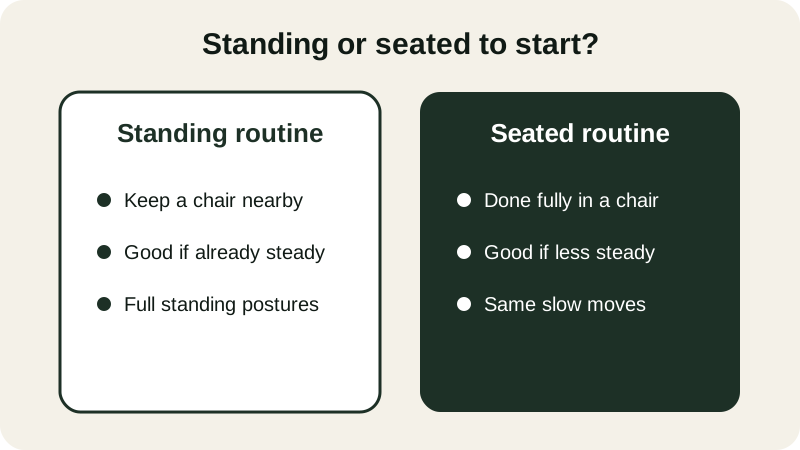
- Standing routine: keep a chair nearby, good if already steady, full standing postures.
- Seated routine: done fully in a chair, good if less steady, same slow moves.
Beyond standing or seated, think about what your body is asking for this particular month — it can change, and that's completely normal.
| Goal | Good starting focus | Guide |
|---|---|---|
| Steadier balance | Gentle weight shifts, heel-to-toe stand | fall prevention |
| Stiff joints | Slow, low-impact moves | arthritis and stiff joints |
| Stress or worry | Wave hands with slow breathing | stress relief |
| Restless sleep | A slow evening wind-down | evening routine |
It's fine to mix rows from this table into one short practice — plenty of people combine a balance move with a calming breath, rather than treating each goal as a separate routine.
Four steps to picking your first routine
If you're starting from nothing, a short decision process beats endless browsing. These four steps take only a few minutes and leave you with a routine you can start today.
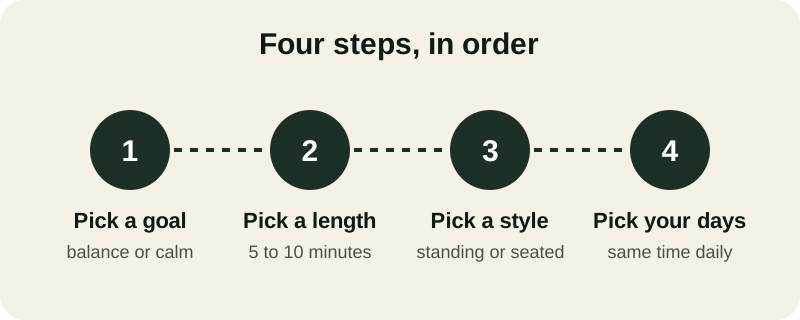
- Pick a goal. Choose the one thing you most want from your practice right now — balance, stiff joints, stress, or sleep — and let that one goal guide which moves you try first, rather than attempting all of them at once.
- Pick a length. Start with 5 to 10 minutes a day rather than one long weekly session; our guide on beginner tai chi session length walks through why short and daily beats long and occasional.
- Pick your style. Choose standing moves if you feel steady on your feet with a chair, wall, or counter nearby, or follow a seated routine from the start if your balance feels shaky right now.
- Pick your days. Settle on which days of the week actually fit your routine, not an ideal one; our guide on how often seniors should practice tai chi can help you set a realistic weekly pace.
Short flow versus the full 24-form routine
Most beginners start with a short flow of a handful of moves, not a long traditional form. A short list of standing moves — things like wave hands, gentle weight shifts, and a single-leg stand — makes a complete little routine in just a few minutes, and it's a far easier entry point than attempting a long sequence right away.
The traditional 24-form routine is a longer, more structured sequence that many people grow into over several weeks, once individual moves feel familiar on their own. If you'd like to see the names of common postures before committing to a longer form, our list of tai chi moves names and our walkthrough of the 24-form for beginners are both good next stops.
It's also worth knowing that tai chi and qigong are close cousins but not identical practices, so if you've been offered a routine labelled qigong, it may look and feel a little different from the flowing tai chi moves described here; our piece on the difference between qigong and tai chi explains how the two compare.
How long should your first sessions be?
Most beginners do best with 5 to 10 minutes a day for the first week or two, adding a few extra minutes only once the moves start to feel familiar. A short session repeated daily builds far more comfort than one long session attempted occasionally.
If you'd like the choosing done for you, Daily Tai Chi builds a personalized 28-day program and lets you pick 5, 10, 15, or 20+ minutes a day. Every session still opens with a warm-up, moves through a main flow, and closes with a cool-down, with spoken cues and a short video clip for each move. Sessions are done standing, with a chair, wall, or counter within reach — if you'd rather stay seated throughout, the chair tai chi guide above covers that on its own. The first 4 days are free, with no card and no account needed.
Once a short routine feels comfortable, you can lengthen it, add a second short session later in the day, or work toward a longer sequence such as the 24-form. None of that is required to call your first routine a success — a few honest minutes, most days, already counts.
Sources
Do you need a different routine for stiff joints than for balance?
Not a different routine so much as a different emphasis. For stiff joints, lean on slow, low-impact moves; for balance, add gentle weight shifts and a heel-to-toe stand. Many beginners simply blend both into one short daily practice.
Is it better to start with a short routine or a longer one?
Start short. Five to ten minutes a day, done consistently, builds comfort faster than one long weekly session. Once the moves feel familiar, most beginners add a few extra minutes rather than lengthening every session right away.
Can you switch routines if the one you picked doesn't feel right?
Yes. Your goal, joints, and balance can all shift over a few weeks, so it's normal to move from a balance-focused routine to a calming one, or from standing moves to a seated practice, whenever that fits better.
Should beginners learn the full 24-form routine before anything else?
Not necessarily. The 24-form is a longer, traditional sequence many people grow into over several weeks, often after starting with a handful of standing moves repeated daily; it isn't required for a first routine to count.