 DAILY TAI CHI
Five Moves to Follow in a Short Tai Chi Flow App
This article explains what makes up a short tai chi flow, five slow moves most beginner flows share, and how a guided, day-by-day path helps you follow the same sequence without relearning it each time.
Published
Quick answer
An app to follow a short tai chi flow guides you through five or six slow moves, like wave hands and gentle weight shifts, in one 5-to-10-minute sequence you can do standing or seated. Each session keeps the same order, so you always know what move comes next.
Key takeaways
- A short flow strings five or six slow moves into one 5-to-10-minute sequence.
- Wave hands, gentle weight shifts, and a heel-to-toe stand are common building blocks.
- Every move can be done seated if standing feels unsteady that day.
- Keep a stable chair, wall, or counter nearby, and stop if you feel dizzy or unsteady.
- Repeating the same order daily makes a flow easier to follow than changing it often.
If you want an app to follow a short tai chi flow instead of guessing at the order of moves, look for one guided routine that walks you through five or six slow postures in the same sequence every time. That is really all a flow is: a handful of movements linked together, done standing or seated, for a few calm minutes.
This guide covers what counts as a short flow, the moves most beginner flows are built from, and how a guided, day-by-day path can make it easy to follow along without relearning the order each morning.
What is a short tai chi flow?

A short tai chi flow is a sequence of five or six slow moves, done in order, that usually takes 5 to 10 minutes from start to finish. It is long enough to feel like a real practice and short enough to repeat every day without it becoming a chore.
Most short flows open with something settling, like standing tall with feet hip-width apart, move through a few gentle weight shifts, and close with a slower, steadier posture. Unlike a full-length tai chi form, which can run much longer, a flow is built to fit into an ordinary few minutes between coffee and the rest of your day.
Think of a flow as a short loop rather than a story you have to memorize scene by scene. Because the same five or six moves repeat in the same order, your body starts to recognize the pattern within a week or two — and recognizing it is what makes the practice feel calm instead of effortful.
A guided routine that presents one short flow at a time removes the guesswork of ordering the moves yourself. Daily Tai Chi, for instance, builds a 28-day path of sessions like this, with the first 4 days free and no card or account needed — a simple way to try a flow before deciding whether to keep going.
Five moves that build a simple flow
Most beginner-friendly flows are not long forms to memorize. They are built from a small, repeatable set of moves used again and again, in a fixed order.
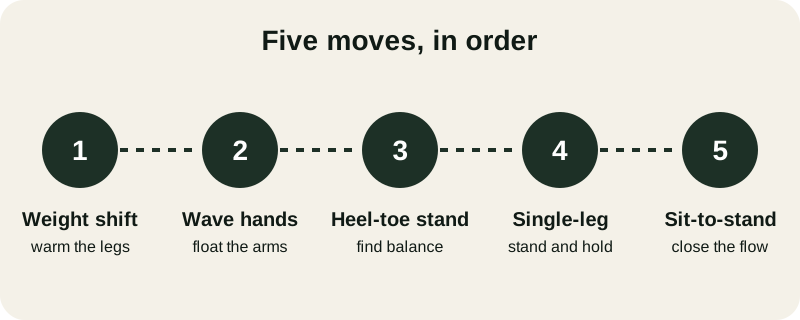
- Weight shift — warm the legs
- Wave hands — float the arms
- Heel-toe stand — find balance
- Single-leg — stand and hold
- Sit-to-stand — close the flow
Each of these is already something you have likely done in daily life without naming it — shifting your weight before standing up, or balancing on one foot to put on a shoe. A short flow simply slows those same actions down and links them into one smooth, unhurried sequence.
Any of these can be done seated if standing is not comfortable that day — our chair Tai Chi guide covers a fully seated version of similar movements.
How long should a short flow take?
Most short flows run 5 to 10 minutes, which is enough time to move through five or six slow postures without rushing. A full practice can be built from two or three short flows back to back — a warm-up, a main flow, and a slower close — and still total well under half an hour.
If mornings suit you better, a 5-minute morning Tai Chi routine is a good length to start with. The same moves adapt just as well to a slower pace later in the day, once you know the order by heart.
Some people prefer two shorter flows instead of one longer one — a brief wake-up sequence in the morning and a slower wind-down sequence in the evening. Either approach works; what matters most is that the length matches a few minutes you can protect on most days, rather than an ambitious block of time you might end up skipping once the day gets busy.
Building a short flow into your day
A flow is easiest to stick with when it has a fixed order you do not have to think about each time. Here is a simple way to set one up:
- Pick a time of day that already has a quiet few minutes — after coffee, or before bed.
- Stand tall, feet hip-width apart, with a stable chair, wall, or counter within reach.
- Move through your chosen sequence once, slowly, without pausing to correct yourself.
- Repeat the same order daily for a week before changing anything.
- Add a second short flow only once the first feels familiar.
This is where a step-by-step path helps: instead of deciding what to practice each day, Daily Tai Chi's 28-day path assigns one guided session at a time, on screens built for iPhone and Android, so the order is already decided before you sit or stand down.
Each session in a path like this also varies the opening slightly — some days start seated, some days standing — so the flow stays familiar without ever feeling exactly repetitive. That small variation is often enough to keep a short practice interesting across the full 28 days.
Mistakes that make a short flow harder to follow
A few habits turn an easy flow into a frustrating one, and they are simple to notice once you know to look for them.
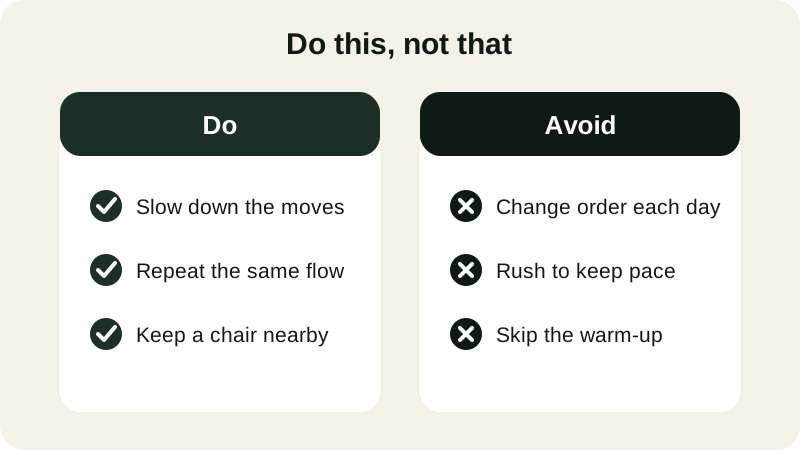
- Do: slow down the moves
- Do: repeat the same flow
- Do: keep a chair nearby
- Avoid: change order each day
- Avoid: rush to keep pace
- Avoid: skip the warm-up
If you notice yourself holding your breath during a move, that is usually a sign you are pushing too hard for the moment. Ease back, breathe slowly, and let the pace settle before continuing — a flow is meant to feel restful, not effortful, from the very first move to the last.
For more on how these same movements support steadiness, our guide on how Tai Chi improves balance goes deeper, and this guide to learning tai chi moves step by step covers the full 28-day path in more detail.
Is there an app that guides a short tai chi flow?
Yes, Daily Tai Chi builds a 28-day path of short guided sessions for iPhone and Android, with the first 4 days free and no card or account needed to start. Each session walks you through one flow at a time, in order, on a clear screen.
Can a short tai chi flow be done sitting down?
Yes, nearly every move in a short flow, including gentle weight shifts and wave hands, adapts to a chair. Sit toward the front of a sturdy seat, keep both feet flat, and follow the same slow order you would use standing.
Do you need a mat or special clothing for a short flow?
No mat is required. Wear comfortable clothes you can move in, go barefoot or wear flat, supportive shoes, and keep a stable chair, wall, or counter nearby for any balance move like a heel-to-toe stand or single-leg stand.
How often should you repeat the same flow?
Most people repeat the same short flow daily for a week or two before changing anything. Familiarity is what makes a flow feel calming rather than effortful; once it feels automatic, you can add a second flow or swap in a new move.