 DAILY TAI CHI
App to Follow a Tai Chi Cool-Down Routine in 5 Moves
This guide explains what a tai chi cool-down routine looks like, how an app can guide you through five slow moves, and how Daily Tai Chi builds one into the end of every guided session.
Published
Quick answer
An app to follow a tai chi cool down routine guides you through slow moves like wave hands and ankle circles for 5 to 10 minutes after your main practice. Each move eases your body toward rest instead of stopping all at once.
Key takeaways
- A cool-down after tai chi usually lasts 5 to 10 minutes of slow moves.
- Wave hands, gentle weight shifts, and ankle circles ease you toward rest.
- Keep a stable chair, wall, or counter nearby for standing moves.
- A steady sit-to-stand is a good signal that practice is ending.
An app to follow for a tai chi cool-down routine gives you slow, guided moves right after your main practice, so your breathing and heart rate settle before you sit down.
A cool-down is the quiet last stretch of a session — the few minutes that ease you out of practice instead of stopping abruptly. It matters as much as the warm-up that opened the session, even though it's easy to skip when you're short on time.
How does an app guide a tai chi cool-down routine?

A tai chi app guides a cool-down the same way it guides the rest of a session: one move at a time, on a large, clear screen, at a slow pace with simple voice and visual cues so you always know when to shift your weight or slow your breath.
In Daily Tai Chi, the cool-down sits at the end of every guided session inside a 28-day path, so a calm finish is always built in rather than left up to you to remember. The first 4 days are free, with no card and no account needed, on iPhone and Android, so you can try a complete cool-down before deciding whether the app fits your routine.
The sessions are built for first-timers and for adults 55+, so nothing moves faster than you're ready for — if a move doesn't feel right, you can always stay with the simpler version.
Many sessions close with a few slow breaths, similar to the ideas in our tai chi breathing techniques guide, so your mind settles along with your body.
Five moves that make up a tai chi cool-down
A simple cool-down moves through five familiar postures, each one smaller and slower than it was during the main flow, so your body eases toward stillness instead of stopping all at once.
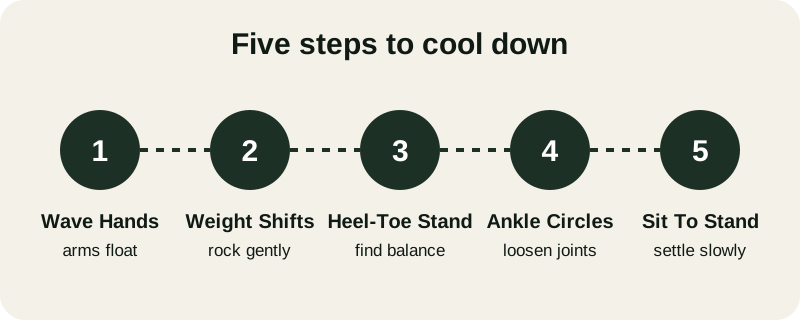
- Wave hands — arms float.
- Weight shifts — rock gently.
- Heel-to-toe stand — find balance.
- Ankle circles — loosen joints.
- Slow sit-to-stand — settle slowly.
Each move stays small. Wave hands softens the arms and shoulders after they've been working through the main flow. The weight shifts and heel-to-toe stand keep asking your balance to work, just softly, while ankle circles release tension that's crept into the lower legs during standing moves. The slow sit-to-stand is the real signal that practice is ending — lower yourself with control, pause, then rise again before settling for good.
If standing for the full set feels like too much some days, every move here adapts to a chair. Rock through the weight shift seated, trace slow circles with pointed toes for the ankle work, and skip the sit-to-stand if you're already seated — the slow breathing still carries the same calming effect. Our chair tai chi guide walks through seated versions of each of these moves in more detail.
The quiet value of finishing slowly
Ending a session gradually gives your body time to catch up with what it just did, rather than snapping from movement straight into sitting still. The slow pace of a cool-down is itself the point — there's nothing to perform and nothing to rush toward.
This is also where the practice turns inward a little. The same unhurried attention you brought to the main flow — noticing your feet, your breath, the small sensations in your hands — carries into the cool-down, just with smaller, quieter movements. Many people describe this stretch of practice, sometimes called meditation in motion, as the part that leaves them feeling calmest.
If stress or a busy mind is part of why you started practicing, a longer cool-down can be worth lingering in. It overlaps closely with standing qigong practice, and if that idea interests you, our qigong for seniors guide is a gentle place to start.
How long should a tai chi cool-down take?
A tai chi cool-down usually takes 5 to 10 minutes, about the same unhurried length as the rest of a short session. Even two or three slow moves done calmly are enough if that's all the time you have.
A cool-down doesn't need to match the length of your main practice. A couple of minutes of wave hands and ankle circles after a quick morning routine still counts; longer isn't automatically better here.
Some people stretch a cool-down a little longer in the evening, letting it flow into a full wind-down. If that sounds like you, our tai chi before bed routine builds on the same slow moves to help you settle in for the night. Others keep it short after a brisk morning session — either way, the moves stay the same, just the number of repeats changes.
A cool-down also pairs naturally with other short practices. You might finish a full 10-minute tai chi routine this way, or close out a seated qigong session with the same slow breathing.
Mistakes that make a cool-down less effective
A few habits quietly undercut a cool-down's purpose, even when the moves themselves are simple and familiar.
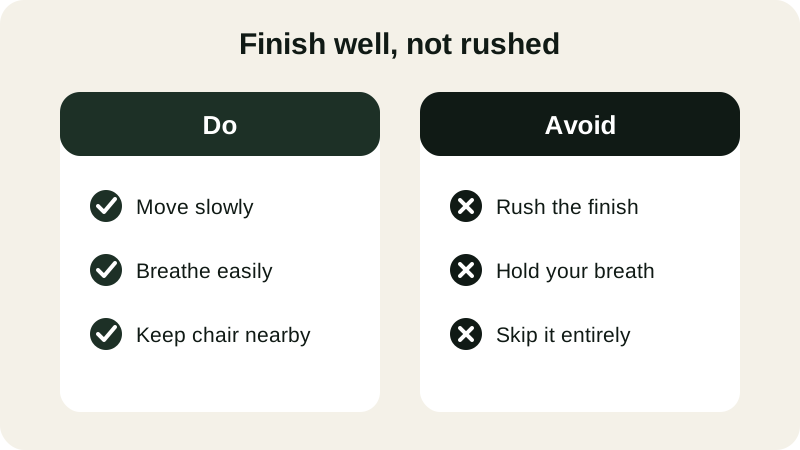
- Do: move slowly.
- Do: breathe easily.
- Do: keep a chair nearby.
- Avoid: rushing the finish.
- Avoid: holding your breath.
- Avoid: skipping it entirely.
Rushing is the most common mistake. It's tempting to stop the moment the main flow ends, but a cool-down needs its own unhurried pace to do its job. Holding your breath during the balance moves is another — let your breath stay slow and continuous, the way it was through the rest of the session.
A slow finish is a small thing, but it's often the part people remember most — the moment practice turns into rest. Pair it with a full session from our tai chi for seniors guide or build a daily habit with our habit-building guide, and the whole practice feels complete from start to end.
Sources
Is a cool-down necessary after a short tai chi session?
Yes. Even a short practice benefits from a slower finish. A minute or two of easy breathing, wave hands, and ankle circles helps your body settle before you move on to the rest of your day.
Can you do the cool-down without the warm-up first?
You can. The slow moves in a cool-down — wave hands, gentle weight shifts — work well on their own as a short calming break. Pairing them with a warm-up and main flow gives a fuller practice, but either way is fine.
Which app includes a guided tai chi cool-down?
Daily Tai Chi builds a cool-down into the end of every guided session as part of its 28-day path, available on iPhone and Android. The first 4 days are free, with no card and no account needed.
What should you do if you feel dizzy during the cool-down?
Stop and sit down gently. Rest a hand on a stable chair, wall, or counter, breathe slowly until the feeling passes, and check with a doctor first before your next session if it happens again.