 DAILY TAI CHI
The Difference Between Qigong and Tai Chi
Qigong is built from simple, repeatable breath-led movements, while tai chi joins those same gentle principles into one continuous flowing sequence.
Published
Quick answer
The difference between qigong and tai chi is that qigong uses simple, repeated movements focused on breath, while tai chi links those motions into one flowing sequence. Both are low-impact and suit complete beginners 55+.
Key takeaways
- Qigong uses simple, repeated movements; tai chi links similar movements into one flowing sequence.
- Both are low-impact, meditation in motion, and suit complete beginners and adults 55+.
- Qigong has no fixed order; tai chi follows a set sequence of named postures.
- You can practice either standing or seated, and many people enjoy combining both.
- The app's 28-day path blends gentle qigong-style breathing with flowing tai chi in 5 to 10 minutes.
The main difference between qigong and tai chi is that qigong uses simple, repeated movements paired with slow breathing, while tai chi links those same gentle principles into a longer, flowing sequence of named postures. Both are low-impact and easy to adapt standing or seated.
If you've watched a slow-movement class in a park, on a video, or in the app and wondered whether you were seeing qigong or tai chi, you're asking a fair question — the two are close cousins. Here's how they differ, and how to decide where to begin.
What exactly is qigong?

Qigong (pronounced "chee-gong") is built from simple, often repeated movements paired with slow, easy breathing. A typical qigong exercise might ask you to raise your arms slowly as you inhale, then lower them as you exhale, repeating the same motion several times in a row.
There's no fixed order to memorize in qigong. You can practice a single movement on its own for a few minutes, or string several together into a short set. Many qigong breathing exercises are built this way — one simple motion, repeated, with your attention resting gently on the breath rather than on remembering what comes next. For a gentle starting point, see our guide to qigong for seniors and beginners.
What exactly is tai chi?
Tai chi takes that same slow, breath-led movement and joins it into one continuous sequence, often called a "form." Instead of repeating a single motion, you move smoothly from one posture into the next — a gentle weight shift flows into a turn, which flows into wave hands, and so on, without stopping between them.
This is why tai chi is often described as meditation in motion: your body keeps gently moving while your mind stays calm and focused on the breath and the next small step. It takes a little more to learn than a single qigong movement, simply because there are more steps to connect, but nothing about it is fast or demanding. If you're brand new to the idea, our beginner's guide to tai chi is a good next stop.
What's the real difference between qigong and tai chi?
So is qigong the same as tai chi? Not quite. Think of qigong as a set of separate, repeatable breathing-and-movement exercises, and tai chi as those same ideas joined into one unbroken routine you move through from start to finish.
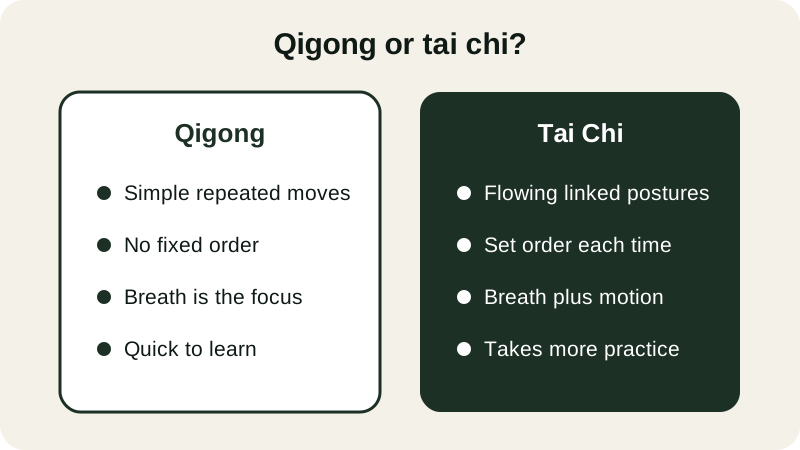
| Aspect | Qigong | Tai Chi |
|---|---|---|
| Movement style | Simple, often repeated | Flowing, connected sequence |
| Structure | No fixed order | Set order of named postures |
| Typical focus | Breath and stillness within movement | Breath plus smooth, linked motion |
| Session length | 5 to 10 minutes | 5 to 10 minutes |
When people weigh tai chi forms vs qigong movements, the short version is this: a form is a fixed sequence you follow start to finish, while a qigong movement can be practiced on its own and repeated as many times as you like. Neither one is more "advanced" than the other — they're simply organized differently.
Which one should you start with?
When people weigh qigong vs tai chi for their very first practice, the honest answer is that either one makes a fine starting point. If you like the idea of a few simple, repeatable moves you can learn in minutes, qigong is a gentle entry point. If you're drawn to a slow, connected routine that feels like a quiet dance, tai chi may suit you better.
You don't have to choose just one. Many people warm up with a qigong breathing exercise or two — gentle weight shifts, ankle circles, a slow sit-to-stand — and then move into a short tai chi sequence once they feel settled and loose.
Can you practice both together?
Yes, and many people do. Qigong and tai chi share the same roots, the same unhurried pace, and the same focus on breath, so moving between them in a single session feels natural rather than jarring. You might open with a minute or two of qigong breathing to settle in, then ease into a short tai chi routine for the rest of your time, perhaps finishing with a quiet single-leg stand or heel-to-toe stand if your balance feels steady that day.
This is the approach the app takes on its 28-day path: short, guided sessions of 5 to 10 minutes that blend gentle qigong-style breathing with flowing tai chi movement, built for complete beginners and adults 55+. You can try the first 4 days free, with no card and no account needed, on iPhone and Android. For more on the breathing side of either practice, our piece on tai chi breathing techniques pairs well with both.
Does it matter which one you choose first?
Not really. Both qigong and tai chi are gentle, low-impact, and forgiving of a slower pace, stiff joints, or an unsteady day. The real difference between qigong and tai chi is simply how the movements are organized — separate and repeatable, or joined into a flowing form — not how much good either one does you.
Give yourself permission to try both for a week or two and notice which one you look forward to returning to. That feeling, more than any rule about which is "better," is the best guide to where to begin.
Sources
Is qigong easier than tai chi for beginners?
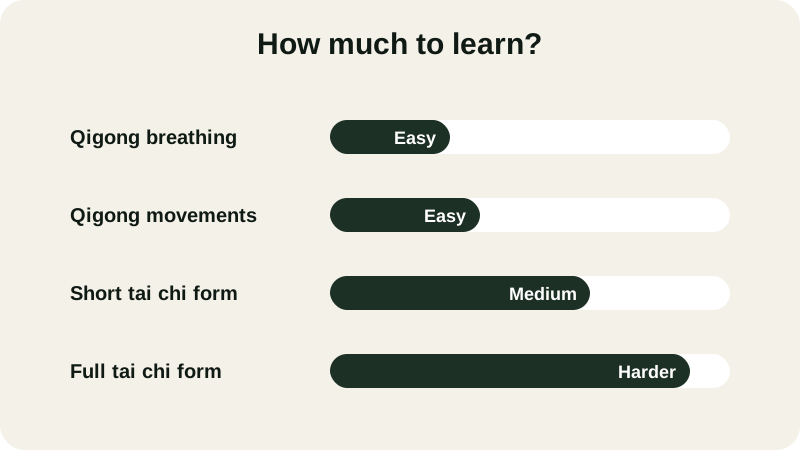
Many beginners find qigong simpler at first because each movement stands alone and can be repeated without worrying about what comes next. Tai chi takes a little more practice to link postures smoothly, but neither one requires any fitness background to start.
Can you do qigong and tai chi on the same day?
Yes. Many people open a session with a minute or two of qigong breathing to settle in, then move into a short tai chi routine. There's no rule against combining them — it's a gentle, natural pairing many beginners enjoy.
Which is gentler on the joints, qigong or tai chi?
Both are low-impact and kind to the joints, since neither involves jumping, fast movement, or deep bending. Qigong's small, repeated motions and tai chi's slow, flowing postures can each be adapted to a standing or seated version.
Do qigong and tai chi offer the same health benefits?
They share the same gentle, breath-led approach, so many people notice similar feelings of calm and steadiness from both. If you have a specific health concern, check with a doctor first about which movement practice best fits your needs.
What does "meditation in motion" mean?
It's a phrase often used for both qigong and tai chi, describing how your body stays gently moving while your mind settles, much like sitting meditation calms the mind through stillness. The movement itself becomes the point of focus.