 DAILY TAI CHI
Tai Chi App to Practice in Small Spaces: Try Wave Hands
This article explains how much space standing tai chi actually needs, which moves fit a small corner, and how a guided app can help you follow a short routine without rearranging furniture.
Published
Quick answer
A tai chi app to practice in small spaces needs only enough floor room to stretch your arms out and turn in a slow circle, about the space of a yoga mat. Keep a stable chair, wall, or counter nearby for the few moves that need extra balance support.
Key takeaways
- Most standing moves fit in a space about the size of a yoga mat.
- Keep a stable chair, wall, or counter within arm's reach for support.
- Wave hands and weight shifts need only enough room to raise your arms.
- A heel-to-toe stand or single-leg stand needs length, not width.
- Clear loose rugs and check overhead space before you begin.
A tai chi app to practice in small spaces works best when every move stays standing, slow, and needs no more room than an arm's reach in any direction. That's enough for a kitchen corner, a cleared rug, or the gap beside your bed.
This style of movement is often called meditation in motion: slow, repeated motion paired with easy breathing. None of it asks for a studio, special shoes, or much open floor — just a little cleared space and something steady to hold onto if you need it.
How much room do you actually need?
Most standing tai chi moves fit in a space about the size of a yoga mat — enough to stretch both arms out to the sides and turn slowly in place. A few moves, like the heel-to-toe stand, need a bit more length than width. Keep a stable chair, wall, or counter within one step for support.
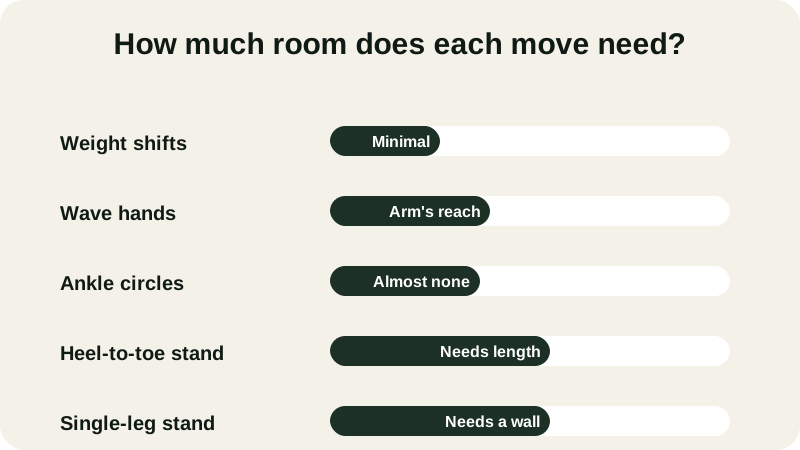
- Weight shifts — minimal space, just your own footprint.
- Wave hands — an arm's reach to each side.
- Ankle circles — almost none, done standing still.
- Heel-to-toe stand — needs length more than width.
- Single-leg stand — needs a wall or chair nearby.
If you live in a small apartment or share a room with furniture, this is good news: standing tai chi in a tight space rarely means squeezing past anything. Stand tall, feet hip-width apart, and check once that you can lift both arms without brushing a lamp or shelf. Most moves stay at shoulder height or below, so low ceilings are rarely an issue.
Moves that fit in a tight corner
A small-space tai chi routine usually leans on a handful of moves that need very little floor: wave hands, gentle weight shifts, ankle circles, and a slow sit-to-stand using a chair for support. Strung together, these make a short sequence you can repeat without ever traveling across the room.
Wave hands keeps your feet mostly still while your arms float side to side, so it works even in a narrow hallway. Weight shifts and ankle circles can be done almost anywhere you can stand still, including right next to a desk or counter. A slow sit-to-stand, using a chair as your anchor, adds a little strength work without needing any extra space at all. A single-leg stand needs only a small footprint, but hold onto a wall or chair until you feel steady lifting one foot a little off the floor.
If you want something with even less movement, slow qigong breathing pairs naturally with these moves and needs no floor space at all. For more moves built around tai chi with limited room and no equipment, see our guide to tai chi at home with no equipment. If you'd rather start from a single still posture before adding movement, our piece on standing meditation covers that in a few quiet minutes.
Why slow movement suits a small room
Tai chi's slow pace is what makes a tight room workable in the first place. Because you're never generating momentum — no jumping, no quick pivots — you don't need the runway a brisk walk or a dance step would require. Each movement can start and stop within a single breath, so a corner that's too small for exercise equipment is often plenty for tai chi.
This slow pace also means you can practice at almost any time of day without worrying about noise or disturbing anyone through a shared wall, which matters if your small space happens to be an apartment.
What a guided app adds when space is tight
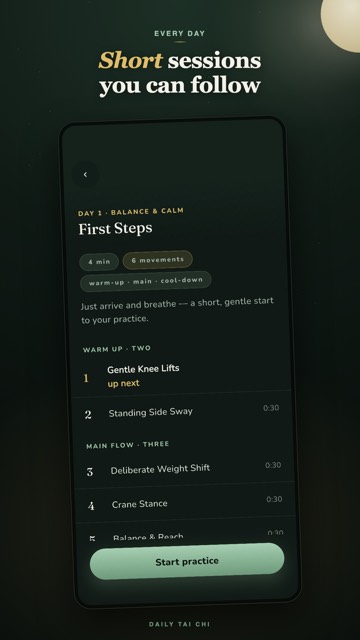
A guided app helps most when it tells you how a move is meant to look before you try it, rather than leaving you to guess how far to step. Daily Tai Chi builds a personalized 28-day path of short sessions — each one a warm-up, a main flow, and a cool-down — stringing together 10 to 30 standing moves shown one at a time, so you never have to memorize a long sequence or wonder what comes next.
You choose 5, 10, 15, or 20-plus minutes a day, and the first 4 days are free, with no card and no account needed to start. It works on iPhone and Android, and a locked day can be opened with an optional ad instead of a payment. The app does send anonymous usage and crash statistics, which is worth knowing if that matters to you.
For a closer look at how the moves are sequenced from day to day, see our guide to the app that teaches tai chi moves step by step.
How do you set up a small practice spot?
Clear a space about the size of a yoga mat, remove loose rugs, and keep a stable chair, wall, or counter within one step. Check that you can raise both arms without touching a lamp or shelf. A few minutes of setup is usually all a small-space tai chi routine needs.
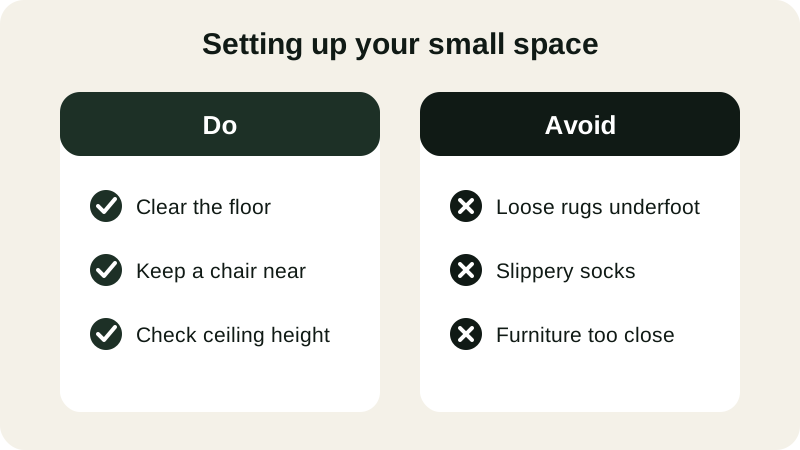
- Do: Clear the floor
- Do: Keep a chair near
- Do: Check ceiling height
- Avoid: Loose rugs underfoot
- Avoid: Slippery socks
- Avoid: Furniture too close
If standing practice still feels like too much space to find on some days, our chair tai chi guide walks through the same slow ideas from a seated position, which you can follow on your own whenever the floor isn't clear. Either way, the goal is the same small, steady corner you return to each day.
Sources
Can you do tai chi in an apartment with low ceilings?
Yes. Most tai chi moves, including wave hands and weight shifts, keep your arms at or below shoulder height, so a standard ceiling is plenty. Check once that you can raise both arms freely without brushing a lamp or shelf before you start a sequence.
Do you need a yoga mat for a small-space tai chi routine?
No, a mat isn't required — bare, stable flooring works fine for a small-space tai chi routine. A thin mat can help if your floor is slippery or very hard, and bare feet or soft-soled shoes usually give better footing than socks on hardwood or tile.
Is there an app that works well for small-space tai chi?
Yes. Daily Tai Chi offers a personalized 28-day path of standing sessions, each built from a warm-up, main flow, and cool-down with 10 to 30 moves shown one at a time. You pick 5, 10, 15, or 20-plus minutes a day, and the first 4 days are free with no card or account needed.
What if your room doesn't have space to turn in a full circle?
Face one direction and adapt turning moves into a half-turn and back, or simply shift your feet instead of pivoting your whole body. Moves like gentle weight shifts and ankle circles don't require any turning at all, so they work in the narrowest spots.