 DAILY TAI CHI
Tai Chi for Improving Daily Mobility: 6 Moves to Try
A short, standing tai chi routine of six simple moves — wave hands, weight shifts, heel-to-toe stand, single-leg stand, sit-to-stand and ankle circles — helps improve daily mobility a few minutes at a time.
Published
Quick answer
Tai chi can improve daily mobility by taking your joints through gentle, repeated motion — wave hands, weight shifts, a heel-to-toe stand and a slow sit-to-stand all make bending, turning and rising from a chair feel easier within a few weeks.
Key takeaways
- Slow, repeated tai chi movement carries joints through their full range without strain.
- Six core moves — wave hands, weight shifts, heel-to-toe stand, single-leg stand, sit-to-stand, ankle circles — target everyday motion.
- Five to ten minutes most days helps mobility more than one long weekly session.
- Keep a stable chair, wall, or counter nearby, and check with a doctor first for joint or balance concerns.
- Stop and rest if you ever feel dizzy or unsteady.
Tai chi can improve your daily mobility by training the exact motions you rely on all day — turning, bending, reaching, and rising from a chair. A few slow minutes, practiced most days, is often enough to notice the difference.
This guide looks at what daily mobility really means, which tai chi moves support it, and how to build a short routine you can return to every day — a goal that matters whether you're 55+ and just getting started, or you've been managing stiffness for years.
Can tai chi really improve daily mobility?
Yes. Tai chi can improve daily mobility because its slow, repeated movements carry your joints through their full range of motion without any jolt or strain, so everyday actions like bending, turning and standing up gradually feel easier.
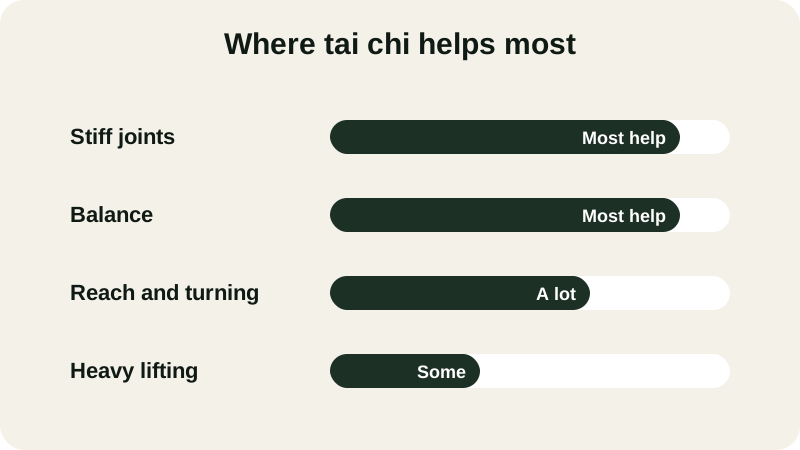
- Stiff joints — most help
- Balance — most help
- Reach and turning — a lot of help
- Heavy lifting — some help
"Mobility" simply means how freely your body moves through ordinary tasks — reaching a top shelf, turning to check behind you in the car, or getting up from the sofa without bracing on the armrest. Tai chi trains this directly, and differently from most exercise. Instead of isolating one muscle at a time, every movement links your ankles, hips, spine and shoulders into a single, continuous motion — which is exactly how your body actually works when you carry groceries, climb a step, or reach into a cupboard.
If one joint in particular feels like the bottleneck, our guides to tai chi for knee pain and tai chi for flexibility in seniors go deeper into loosening a specific area, while this article stays focused on movement as a whole.
Six simple moves for everyday movement
A short, standing sequence of familiar tai chi moves covers most of what daily mobility asks of you: shifting weight smoothly, balancing on one leg for a moment, turning without stiffness, and rising from sitting under control.
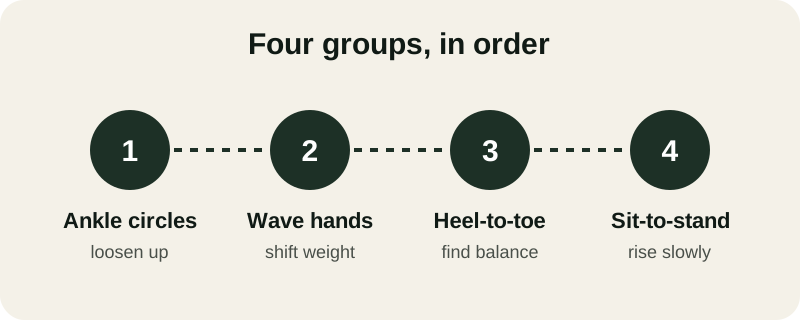
- Ankle circles — loosen up
- Wave hands — shift weight
- Heel-to-toe — find balance
- Sit-to-stand — rise slowly
Here is what each move asks of your body, and why it matters for daily life:
- Ankle circles. Stand tall, feet hip-width apart, holding a stable chair, wall, or counter. Lift one foot slightly and trace slow circles with your ankle in both directions, then switch feet. This wakes up a joint that nearly every other movement depends on.
- Gentle weight shifts. Rock your weight slowly from one foot to the other, keeping your knees soft rather than locked. This is the same motion as walking, just slowed down enough to actually feel it happening.
- Wave hands. Turn gently from side to side while your arms float and curve in front of you, like smoothing the surface of water. It links hip rotation with shoulder movement, which is useful whenever you reach across a counter or turn to answer someone.
- Heel-to-toe stand. Place one foot directly in front of the other, heel touching toe, as though standing on a line, and hold for a few slow breaths. This mirrors the narrow stance you use crossing a doorway or a crowded room.
- Single-leg stand. Holding your support, lift one foot an inch or two off the floor. Hold for a slow count, then switch. This builds the steadiness that stairs, curbs, and uneven pavement all ask of you.
- Slow sit-to-stand. Lower yourself into a chair with control, pause, then rise just as slowly, using your hands as little as you need to. Few daily movements matter more than getting up from a chair with confidence.
Breathing ties all six moves together. Let your breath lengthen naturally as you move — in as you shift weight back, out as you shift forward — rather than holding it. For more on this pairing, our tai chi breathing exercises guide is a gentle place to start.
Stop if you ever feel dizzy or unsteady, and keep your support within arm's reach the whole time you practice.
Building a short daily mobility routine
Daily mobility improves with consistency rather than intensity — five to ten minutes done most days does more than one long session saved for the weekend.
- Stand tall, feet hip-width apart, with a stable chair, wall, or counter within reach.
- Warm up with a minute of ankle circles and gentle weight shifts.
- Move through wave hands for a minute or two, breathing slowly and evenly.
- Try a heel-to-toe stand, holding for a few breaths on each side.
- Add a single-leg stand only if you feel steady, switching legs partway through.
- Finish with several slow sit-to-stands from a sturdy chair.
Some days you may only manage the first two steps, and that is still worthwhile. On days when standing for the full sequence feels like too much, our chair tai chi guide walks through many of the same ideas from a seated position. Small, steady practice is what moves the needle, not perfect form.
How does the app support a daily mobility practice?
Daily Tai Chi turns this into a 28-day path of short, guided sessions — each with a warm-up, main flow and cool-down — so you are not left guessing which moves to string together on a given day. Sessions are done standing, with spoken cues and a short video clip for each move, and you choose 5, 10, 15 or 20+ minutes depending on how much time you have. The first 4 days are free, with no card and no account, on iPhone and Android, and a daily reminder can nudge you at whatever time fits your own routine.
For a closer look at how a guided session is put together, see our guide to the app's guided sessions, and for the fuller beginner picture, our tai chi for seniors guide is a good next stop.
How soon will you notice better daily mobility?
Many people notice small changes — an easier time rising from a chair, or turning to look behind them — within the first couple of weeks of five to ten minutes of practice most days. Bigger changes, like steadier footing on uneven ground, tend to build gradually over a few months of regular practice.
Is tai chi safe if you have stiff knees or hips?
Tai chi is generally gentle enough for stiff knees or hips, since the movements are slow and low-impact rather than jarring. Keep a stable chair, wall, or counter nearby, move at whatever pace feels comfortable, and talk with a doctor first if you have a specific joint condition or balance concern.
Can you practice these mobility moves sitting down?
Yes — several of these motions adapt well to a chair: wave hands and weight shifts both work seated, and ankle circles are easy with feet flat on the floor. Balance moves like the single-leg stand are safest practiced standing, close to a stable chair, wall, or counter.
What's the difference between tai chi and qigong for mobility?
Both use slow, mindful movement, but tai chi links postures into one continuous flowing sequence, while qigong often repeats a single posture or breathing pattern in place. Either style can support daily mobility; some people pair flowing tai chi moves with simple qigong breathing to loosen up and settle the mind.