 DAILY TAI CHI
How Long Does It Take to Learn Tai Chi? 28 Days
Most beginners feel comfortable with basic tai chi moves within a few weeks of short daily practice, and a full short routine often flows naturally after about a month.
Published
Quick answer
How long it takes to learn tai chi depends on your pace, but most beginners feel comfortable with basic moves within a few weeks of short daily practice. A full short routine often flows naturally after about a month.
Key takeaways
- Most beginners feel comfortable with basic moves within a few weeks of short daily practice.
- A full short routine often starts to flow naturally after about a month.
- Short daily sessions of 5 to 10 minutes build moves into memory faster than rare long ones.
- Tai chi keeps deepening for years — there's no single finish line, only steadier practice.
- Consistency, not natural talent, is the main factor in how quickly you progress.
Learning tai chi takes most beginners a few weeks to feel steady with the basic moves, since the slow pace itself is part of what you're learning. Many people call it meditation in motion for exactly that reason.
How long does it take to learn tai chi basics?

Most beginners feel steady with the basic stance, wave hands, and gentle weight shifts within one to two weeks of short daily practice. By the end of a month, a simple sequence usually flows without much hesitation, though tai chi keeps deepening for years after that first steady feeling arrives.
Everyone moves at their own pace. Some people feel confident after a single week of practicing five to ten minutes a day; others take closer to six or eight weeks before a short flow feels automatic. Neither pace is wrong — the point of tai chi is steady, unhurried progress, not a race to the finish.
What changes fastest is usually confidence, not correctness. Most beginners can repeat a few basic moves from memory within the first week, even if the form isn't yet smooth. Smoothness tends to arrive a little later, once the body has repeated a movement enough times that it no longer needs conscious thought to recall the sequence.
Three things shape how fast you learn tai chi
A few habits shape how quickly tai chi starts to feel natural: how often you practice, whether you warm up first, and how much you let yourself move slowly instead of rushing to get it right. Consistency matters far more than natural flexibility or fitness level.
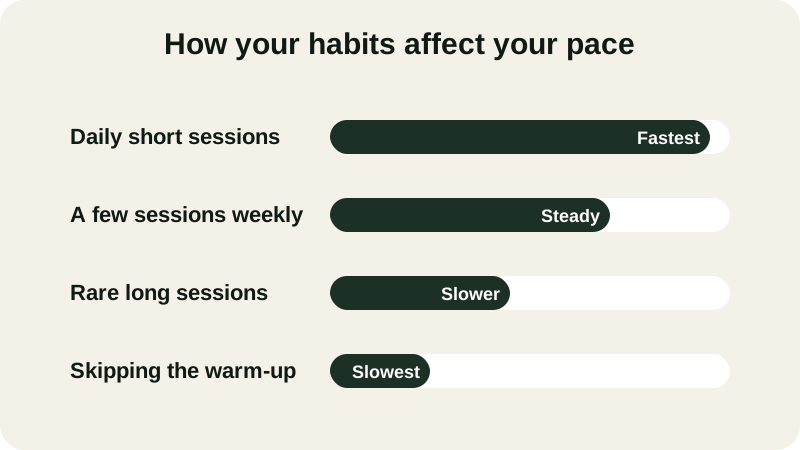
- Daily short sessions – fastest
- A few sessions weekly – steady
- Rare long sessions – slower
- Skipping the warm-up – slowest
If you already enjoy slow, mindful movement — from qigong, easy stretching, or a quiet daily walk — picking up tai chi can feel especially natural. If you're newer to that kind of movement, give yourself more patience; the moves still land the same way, just with a bit more repetition. Our guide to qigong for seniors and beginners is a nice companion practice if you'd like to compare the two kinds of slow movement side by side.
Warming up matters more than many beginners expect. A few minutes of ankle circles and slow weight shifts loosen stiff joints and help the nervous system settle into a slower rhythm before the main moves begin. Skipping that step doesn't just feel less pleasant — it tends to make the main sequence harder to follow, because your body is still catching up to the pace.
A realistic timeline for your first month
Here's roughly what a first month of practice looks like, broken into four stages most beginners move through, from finding a comfortable stance to linking several moves into one smooth sequence.
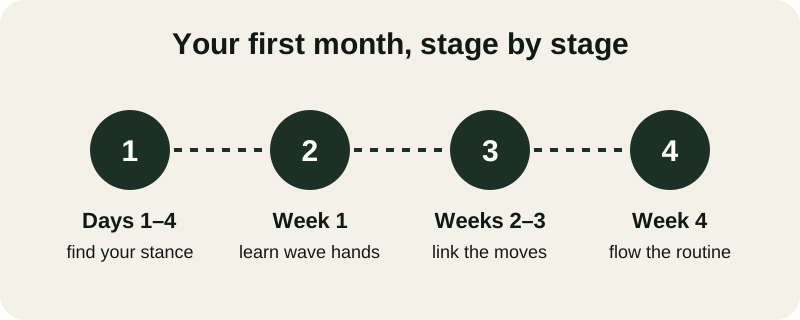
- Days 1–4: find your stance
- Week 1: learn wave hands
- Weeks 2–3: link the moves
- Week 4: flow the routine
The app builds this same shape into a 28-day path: each day offers one short, guided session with slow, step-by-step moves, so you're never guessing what comes next. The first four days are free to try, with no card and no account needed, so you can feel out the pace before committing to anything further. Sessions run five to ten minutes and work on both iPhone and Android.
Having some kind of set order to follow each day removes a lot of guesswork. Instead of wondering which move comes next, you simply repeat the same short sequence, one day at a time, until it feels like second nature.
Do you ever finish learning tai chi?
Not entirely — tai chi doesn't wrap up the way a short course does. Most people feel solid in the basics within a month, yet breath, balance, and small details keep refining for years afterward. Once the basics feel easy, many beginners move on to longer forms and subtler variations.
There's no single moment where you're declared finished, and that's part of the appeal. Each small refinement — a softer knee, a steadier breath, a more even weight shift — becomes its own quiet reward along the way.
If you'd like a next challenge once the basics feel comfortable, the 24 form for beginners is a popular next step, and our list of common tai chi moves and names is a handy reference as your vocabulary grows.
Mistakes that slow down beginners
A few habits make the learning curve feel longer than it needs to be.
- Practicing only once a week. Short, frequent sessions build memory in the muscles far better than one long session.
- Skipping the warm-up. A few minutes of ankle circles and slow weight shifts help the rest of the routine feel easier to follow.
- Rushing through the moves. Tai chi rewards slow, complete motion — speeding up actually makes a sequence harder to remember.
- Comparing your pace to someone else's. Everyone settles into the rhythm at a different speed, and that's perfectly fine.
- Trying to learn too many moves at once. Focusing on a handful of moves until they feel familiar builds a sturdier foundation than spreading attention across a long sequence too soon.
How much should you practice each day?
Five to ten minutes most days is enough to make steady progress — far more effective than an occasional long session. Short sessions let new moves settle into memory gradually, without tiring your joints or your patience.
If you'd like a ready-made short session to start with, our five-minute morning routine and ten-minute seniors routine are both easy places to begin, and either one fits naturally into the kind of daily rhythm that helps tai chi click sooner rather than later.
However long it takes you to feel steady, the goal was never speed. It's a few calm, unhurried minutes that quietly become part of your day — and over the weeks, those minutes add up into something that feels less like a task and more like a habit you look forward to.
Sources
Can you learn tai chi from videos alone?
Yes, many beginners learn well from short guided videos that show each move step by step and repeat it until it feels familiar. If you'd like occasional feedback on your form too, pairing solo practice with a local class now and then is a comfortable combination.
Does age affect how long it takes to learn tai chi?
Not in any fixed way. Adults 55+ learn the basic moves at their own comfortable pace, often just as quickly as younger beginners, since every movement is adaptable to standing or seated practice. Patience and regular short sessions matter far more than age.
How many tai chi moves should a beginner know first?
A handful is plenty to start: a relaxed stance, wave hands, a slow weight shift, and perhaps a heel-to-toe stand. Learning a few moves well builds a steadier foundation than trying to pick up a long sequence all at once.
What if you miss several days of practice?
Simply pick back up where you left off, at a comfortable pace. Tai chi responds well to returning slowly rather than trying to catch up all at once — a short session today matters more than worrying about the days you missed.