 DAILY TAI CHI
Fit Tai Chi Into a Busy Schedule: 3 Micro-Sessions
This article shows how to fit tai chi into a busy schedule by splitting practice into three short slots and anchoring each one to an existing daily habit.
Published
Quick answer
You can fit tai chi into a busy schedule by splitting practice into three short slots—morning, a midday break, and evening—of about five minutes each instead of waiting for one long session. Attaching each slot to a habit you already have, like coffee or dinner, makes it easier to keep up.
Key takeaways
- Split practice into three 5-minute slots instead of one long session.
- Attach tai chi to a habit you already have, like morning coffee.
- Five minutes of slow movement still counts as a full practice.
- A set time beats waiting for free time to appear.
- Standing tai chi needs just a chair, wall, or counter nearby.
The simplest way to fit tai chi into a busy schedule is to trade one long workout for three or four short slots of five to ten minutes. A few minutes in the morning, a break at midday, and a few more before dinner add up to a real practice without ever feeling like a big commitment.
Most people who try to squeeze slow movement into a packed week don't fail because tai chi takes too long. They fail because they're waiting for a clear hour that never shows up. The fix isn't finding more time — it's lowering the size of each session until it fits the time you already have.
How do you fit tai chi into a busy schedule?
You fit tai chi into a busy schedule by trading one long workout for several short slots — five to ten minutes, two or three times a day — and anchoring each one to something you already do, like right after you wake up or right before you sit down for dinner. Slow movement counts even in small doses.
Tai chi was built around this kind of flexibility already. A round of gentle weight shifts or wave hands takes less time than brewing a pot of tea, and it asks for nothing special — no gym clothes, no equipment, no warm-up lap around the block. All it needs is a clear patch of floor, a stable chair, wall, or counter within reach, and a few quiet minutes.
That last part matters more than people expect. A five-minute slot you actually do beats a sixty-minute class you keep rescheduling. Once you stop thinking of tai chi as a workout to squeeze in and start thinking of it as a short pause you take a few times a day, the scheduling problem mostly disappears.
Three ways to split tai chi across your day
Most people settle into one of three patterns: a short session first thing in the morning, a break built into the middle of the day, or a wind-down slot in the evening. You don't have to pick just one right away — try each for a few days and see which one actually survives your week.
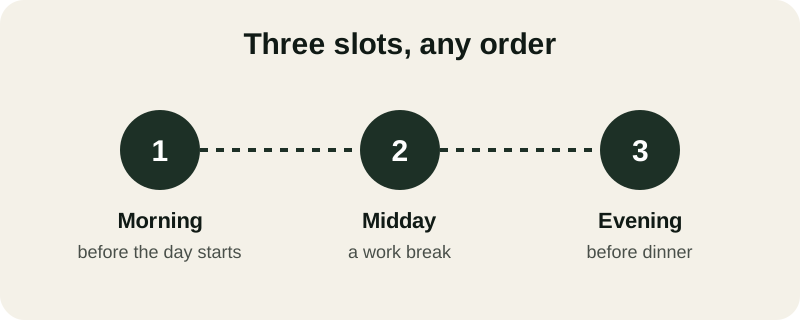
- Morning — before the day starts, right after you're up and dressed.
- Midday — a work break, away from your desk or kitchen table.
- Evening — before dinner, as a way to close out the day.
If mornings are the only quiet stretch you have, the 5-minute morning tai chi routine is built for exactly that slot. If your calm moment comes after work instead, the after-work tai chi routine covers the same idea with a short set of moves to close out the day.
What if you only have five minutes?
Five minutes is enough for a complete short practice: a minute of gentle weight shifts to settle in, two or three minutes of a simple move like wave hands, and a minute to breathe and let your shoulders drop before you go back to your day.
You don't need a long warm-up to make a short slot worthwhile, and you don't need to finish a whole sequence for it to count. This is also where a guided option earns its keep: the app's 28-day path lets you choose 5, 10, 15 or 20+ minutes a day and set a daily reminder at a time you choose, so a five-minute day still fits the plan instead of feeling like you skipped it.
Stacking tai chi onto habits you already have
The easiest schedule is the one you don't have to remember. Pick something you already do every single day without fail — making coffee, brushing your teeth, letting the dog out — and slot your tai chi right before or right after it.
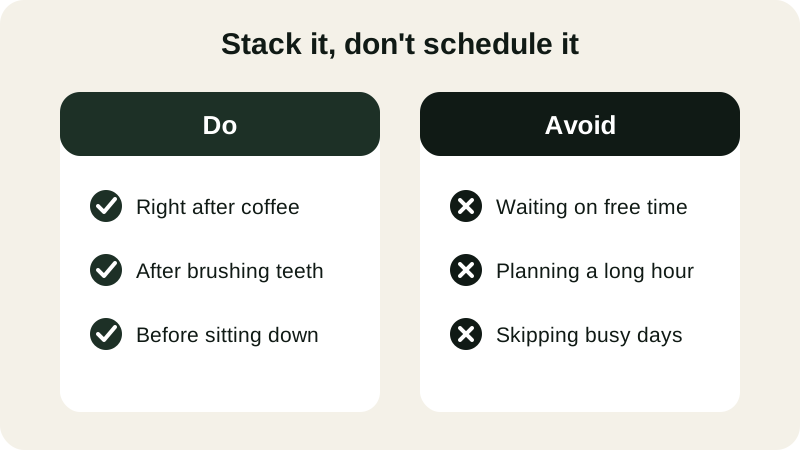
- Do: right after coffee, after brushing teeth, before sitting down.
- Avoid: waiting on free time, planning a long hour, skipping busy days.
Once a slot is attached to a habit, it stops being a decision you have to make every day — it just happens, the same way brushing your teeth happens. For more ways to keep a short practice going once the first week's novelty wears off, see our guide on staying consistent with a tai chi practice, and if remembering is still the sticking point, our piece on setting a daily reminder for tai chi practice covers three simple ways to do it.
A busy schedule doesn't have to push tai chi out entirely. Shrink the session, anchor it to something you already do, and let a few short slots do the work that one long one never got around to doing.
Can you practice tai chi during a work break?
Yes. A work break is long enough for a short round of gentle weight shifts or wave hands near your desk or a quiet hallway. Keep a stable chair, wall, or counter nearby if you feel unsteady, and save longer sequences for a session at home.
Does splitting tai chi into short slots work as well as one long session?
Short slots done consistently add up to more practice over a week than an occasional long session you keep postponing. Each slot still includes slow weight shifts and steady breathing, so the benefit comes from showing up often, not from how long any single sitting lasts.
What time of day works best for a quick tai chi session?
Whatever time you're most likely to actually do it. Many people find mornings easiest because nothing has crowded the calendar yet, while others prefer a midday break to reset or an evening slot to unwind. Try a few days at each time and keep the one that sticks.
How do you remember to practice on busy days?
Attach the session to something you already do without fail, like making coffee or locking the front door, so the existing habit reminds you. A phone alarm or calendar note at the same time each day works too, if you'd rather not rely on memory alone.