 DAILY TAI CHI
Tai Chi for Winding Down After Work: A 4-Move Routine
A short, slow tai chi routine built around wave hands and weight shifts that helps you unwind after work in five to ten minutes.
Published
Quick answer
A short, slow tai chi practice is one of the simplest ways to spend time winding down after work: a few minutes of wave hands and weight shifts ease tension built up during the day. Five to ten minutes, done standing, helps shift from work mode into evening calm.
Key takeaways
- Five to ten minutes of slow tai chi can ease the shift from work mode to evening calm.
- Wave hands and weight shifts are easy moves to start with after a long day.
- Practice standing, with a stable chair, wall, or counter nearby for support.
- Pairing movement with slow breathing helps your body register the workday is over.
- A fixed time, like right after you get home, makes the habit easier to keep.
Tai chi is a simple, reliable way to practice winding down after work: a few slow minutes of movement and breath help your body shift out of work mode before the evening begins.
You don't need a mat, special shoes, or a quiet studio for this. You can start right where you're standing, still in your work clothes, with a stable chair, wall, or counter nearby if you'd like a hand to steady yourself — a kitchen, a hallway, or the space beside your desk is plenty of room.
Why does tai chi help you wind down after work?
Tai chi helps you wind down after work because its slow, continuous movement and steady breathing give your nervous system time to catch up with the day's changes. Instead of moving straight from screens and meetings into dinner, you take a few quiet minutes to shift gears, on your own two feet.
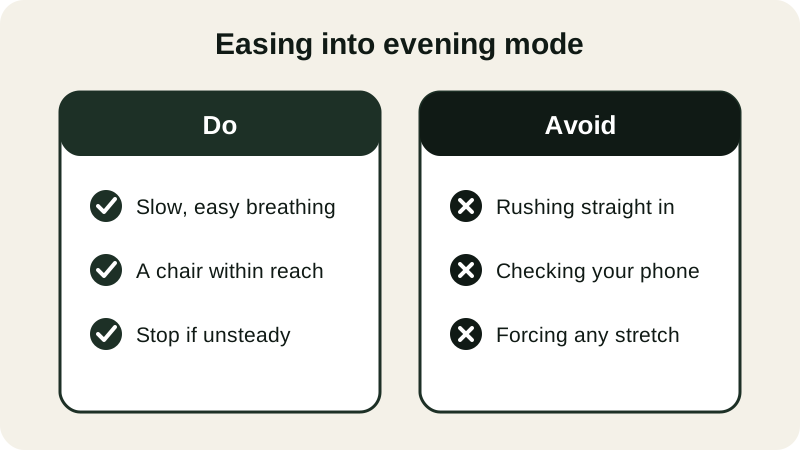
- Do: slow, easy breathing
- Do: a chair within reach
- Do: stop if unsteady
- Avoid: rushing straight in
- Avoid: checking your phone
- Avoid: forcing any stretch
Work stress tends to collect in the shoulders, the jaw, and the breath, and all three grow shallow and tight by the end of a desk-bound or screen-heavy day. The slow turns and wave hands motion of tai chi ask your arms and spine to move in wide, easy arcs, which naturally deepens your breathing and loosens the muscles around your neck and shoulders. Even a few minutes of this slower pace gives your body a clear signal that the pace of the day has changed. For more on how breath itself does this work, see our guide to tai chi breathing exercises.
This matters most on the days that felt rushed, noisy, or full of small decisions — back-to-back calls, a crowded commute, a dozen unanswered messages. Tai chi doesn't erase any of that, but it gives your body a short, clear stop between one mode and the next, which many people find makes the rest of the evening feel calmer.
Four slow moves to try after work
These four moves come from a typical tai chi warm-up and flow, and each one is low-impact enough to do in socks or flat shoes after a long day. Move at an easy pace, and keep a stable chair, wall, or counter nearby in case you want extra support.
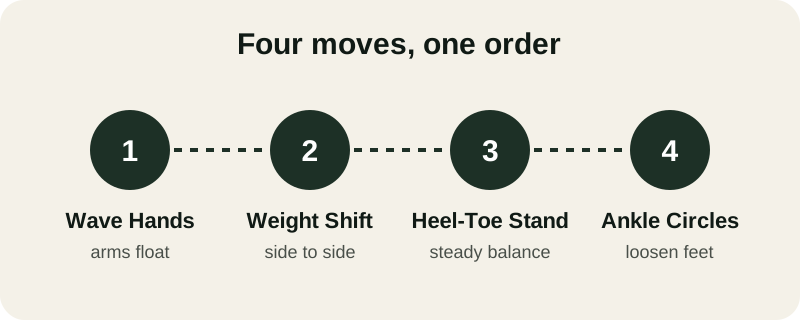
- Wave Hands — arms float, side to side
- Weight Shift — ease side to side
- Heel-Toe Stand — steady your balance
- Ankle Circles — loosen the feet
Stand tall, feet hip-width apart, knees soft rather than locked. For wave hands, let your arms float up to chest height and drift side to side as if you're smoothing the surface of calm water, while your weight rocks softly from one foot to the other. Move into a gentle weight shift next, rocking your weight from foot to foot without lifting your heels off the floor — this alone can loosen hips that have been sitting all day. Then try a heel-to-toe stand, placing one foot directly in front of the other for a few slow breaths; resting a hand on the back of a chair is perfectly fine here, and there's no need to hold the position any longer than feels comfortable. Finish with slow ankle circles, seated or standing, to release tension that's gathered in your feet and calves from a day spent sitting at a desk or standing at a counter.
How long should an after-work tai chi practice be?
Five to ten minutes is plenty for an after-work tai chi practice. That's enough time to move through a short sequence like wave hands, a weight shift, and a few ankle circles, slow your breathing, and feel the shift from work mode into evening, without turning it into another task on your list.
On an especially draining day, you might only manage the shorter end of that range, and that's fine — a few slow breaths paired with wave hands still counts. On a calmer day, or a weekend evening, you might naturally drift toward the longer end simply because it feels good to keep going. If you have more time or more tension to release, there's nothing wrong with staying longer. Our guides to reducing muscle tension and calming the nervous system pair naturally with an after-work session, especially if you practice in the hour before dinner.
Making this part of your evening routine
The easiest way to keep an after-work tai chi habit going is to tie it to something you already do, like changing out of work clothes or putting the kettle on. It doesn't need to be elaborate — the point is simply doing it at the same point in your evening, night after night, so it stops feeling like a decision.
If you'd like a steady hand guiding you through this, Daily Tai Chi builds a 28-day path of short, standing sessions — each with a warm-up, main flow, and cool-down — and lets you set a daily reminder at a time you choose, such as the moment you walk in the door after work. Sessions run 5, 10, 15, or 20+ minutes, and the first 4 days are free, with no card and no account, on iPhone and Android.
Small, consistent sessions tend to stick better than occasional long ones. If you want more ideas for keeping a short practice going through busy weeks, our guide on how to stay consistent with a tai chi practice walks through a few practical habits that make the difference. For more ways to settle into the evening, see our guide to tai chi for sleep and an evening wind-down, or if you'd rather start seated, our chair tai chi guide walks through seated moves you can follow on your own. Whichever path you choose, the goal is the same: a few unhurried minutes that help today's work stay at the office, not follow you into the evening.
Is it bad to do tai chi right after a stressful day instead of resting on the couch?
No single approach works for everyone, so if you're exhausted, resting first is fine. Many people find a few slow minutes of movement — even just wave hands and a slow weight shift — settles a racing mind faster than sitting still, because movement gives restless energy somewhere to go before you rest.
What if you don't have time for tai chi every evening?
Three or four evenings a week still adds up. A short five-minute session on the days you can manage keeps the habit alive, and an occasional missed evening won't undo the calm you've built — just pick it back up the next day without starting over.
Can tai chi replace a wind-down routine that includes stretching?
You don't have to choose one or the other. Tai chi's slow, flowing movement already stretches the shoulders, hips, and spine as you go, so it can stand on its own or sit alongside a few extra stretches, whichever feels better for your body that particular evening.
Does it matter what time in the evening you practice?
Right after work, before dinner, or just before bed all work well — the best time is whichever one you'll actually repeat. Some people prefer practicing the moment they walk in the door; others wait until the house has gone quiet later at night.