 DAILY TAI CHI
Tai Chi for Improving Sleep Quality: 4 Moves Before Bed
A short evening tai chi routine of wave hands, weight shifts, ankle circles and a heel-to-toe stand can calm the body and support better sleep quality.
Published
Quick answer
Tai chi for improving sleep quality works through slow breathing and gentle, repetitive movement in the hour before bed, which helps your body shift out of daytime alertness. A short routine of wave hands, weight shifts and ankle circles is enough to start winding down.
Key takeaways
- A 5 to 10 minute evening practice of wave hands and gentle weight shifts helps the body wind down before bed.
- Ankle circles and a heel-to-toe stand ease leg and foot tension after a day of sitting or standing.
- Practice in dim light, 30 to 60 minutes before bed, away from bright screens.
- Stop any move that feels dizzy or unsteady, and check with a doctor first if you have health concerns.
- Consistency matters more than length — a few calm minutes most evenings beats one long session.
Practicing tai chi in the evening can improve your sleep quality by slowing your breathing and easing tension in the body before you lie down. It works less like a sleep aid and more like a quiet bridge between a busy day and a settled night.
This is the same slow, flowing style often called meditation in motion — no jumping, no rushing, just gentle weight shifts and soft breath. A short practice in the hour before bed can help your mind and body get the message that the day is winding down.
Can tai chi help you sleep better?

Yes. Slow, repetitive movement paired with steady breathing is a reliable way to calm an active nervous system, and a calmer nervous system is easier to fall asleep with. Tai chi won't knock you out like a sedative, but it gives your body a consistent, low-effort way to downshift before bed.
Groups such as the NCCIH, MedlinePlus, and Harvard Health Publishing all list slow, relaxing movement among the everyday habits people use alongside good sleep routines. Results differ from person to person, so it helps to treat an evening tai chi practice as one supportive habit among several — alongside a regular bedtime and a dim, quiet room — rather than a stand-alone fix.
What sets tai chi apart from simple stretching is the breath. Each movement is timed to a slow inhale or exhale, so by the time you finish a short sequence, your breathing rate has already dropped on its own, without you needing to count or force it.
Why evening movement calms the body
Your body relies on cues to know when it's time to rest — dim light, a quieter room, slower movement. Tai chi gives it one more cue: a few minutes of unhurried motion that signals the "go" system of the day to ease off.
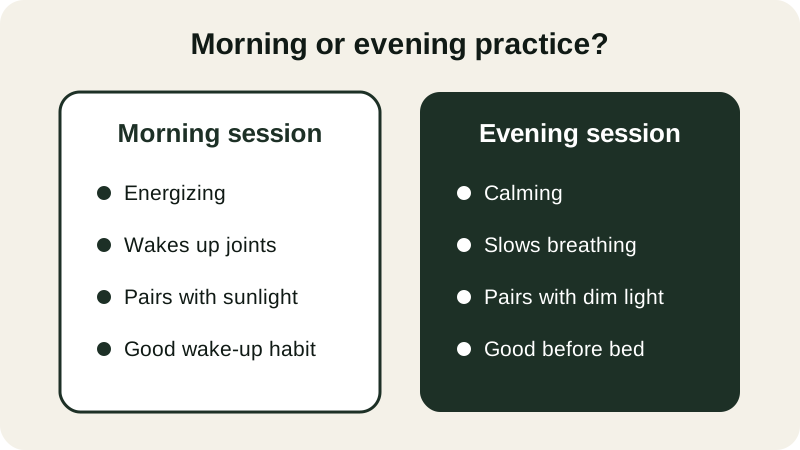
- Morning session: energizing, wakes up joints, pairs with sunlight, good wake-up habit
- Evening session: calming, slows breathing, pairs with dim light, good before bed
Either time of day is worth practicing, but if sleep quality is your goal, the evening slot is where the calming effect does its best work. The breathing side matters as much as the movement — for a closer look at slowing your breath on purpose, see our guide to Tai Chi breathing exercises.
If your evenings are unpredictable — late dinners, a phone call, grandchildren visiting — don't worry about finding a perfect hour. Even a shortened version of your usual sequence, done whenever you first sit down for the night, still gives your body the same slowing cue.
Four slow moves to try before bed
A short, familiar sequence works better than trying something new right before sleep. These four moves are gentle enough to do in socks on a soft rug, a few feet from your bed.
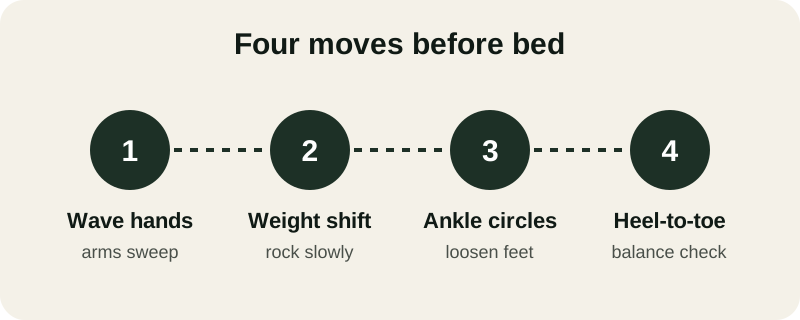
- Wave hands – arms sweep slowly side to side
- Weight shift – rock gently from foot to foot
- Ankle circles – loosen each ankle, one at a time
- Heel-to-toe – a quiet balance check, holding a chair if needed
Stand tall, feet hip-width apart, with a stable chair, wall, or counter nearby in case you need it. If standing isn't comfortable tonight, every one of these moves adapts to sitting — our chair Tai Chi guide walks through a seated version of the same slow rhythm.
You don't need to memorize a strict order. Many people simply repeat wave hands for a minute, shift their weight a few times, circle each ankle, then finish standing still with their eyes half-closed for a few slow breaths. The exact sequence matters far less than keeping the pace slow and the mind unhurried.
The best time to practice before bed
Five to ten minutes is plenty, done roughly 30 to 60 minutes before you plan to sleep. That gap gives your body time to settle after the movement ends, rather than going straight from motion to pillow.
Keep the room dim and skip bright screens right after you finish — the point is to protect the calm you just built, not undo it scrolling in bed. A consistent slot matters more than a long one: after dinner cleanup, or right after brushing your teeth, works well simply because it's repeatable.
If remembering to practice is the hard part, Daily Tai Chi lets you set a daily reminder at a time you choose, so the prompt lands right when you want to wind down. Each guided session strings together a warm-up, main flow and cool-down from a personalized 28-day path, done standing with a stable chair, wall, or counter within reach. The first 4 days are free, with no card and no account needed, on iPhone and Android.
Some nights you'll have ten minutes, other nights barely three. Both count. A brief, familiar routine done consistently will do more for your sleep quality over the weeks than an occasional long session squeezed in once in a while.
Habits to avoid right before bed
Skip anything that revs you back up. Bright screens, fast movement, or trying to learn a brand-new sequence all work against the calm you're trying to build.
- Avoid checking your phone right after practice
- Avoid learning new, unfamiliar moves close to bedtime
- Avoid rushing through the sequence to finish faster
Keep the sequence familiar, keep the pace slow, and let the last move — often a few quiet breaths standing still — be the actual last thing you do before you head to bed. A cold, dark room and a consistent wind-down time matter too, but the movement and breath are what you have the most direct control over each night.
For a full wind-down sequence built around this same idea, see our evening routine guide, and if a busy mind is part of what keeps you up, our piece on calming the nervous system pairs naturally with this practice.
Sources
Does practicing tai chi earlier in the day still help sleep quality?
Yes, a daytime or morning session still builds the same slow-breathing habit, even though it tends to energize rather than calm. If evenings are hard to protect, keep a short morning practice and add a few quiet minutes of stretching or slow breathing before bed instead.
Can tai chi replace sleep medication?
No, tai chi is not a substitute for medication or medical treatment. Check with a doctor first if sleep trouble is ongoing. Tai chi works well alongside whatever plan a doctor recommends, as a calming addition to your evening rather than a replacement for care.
How many nights a week should you practice for better sleep quality?
Most evenings works better than one long weekly session. Aim for at least three or four nights a week of five to ten gentle minutes, since a steady cue repeated often teaches your body to wind down faster than an occasional longer practice.
Is it normal to feel sleepy right after an evening tai chi session?
Yes, a pleasant drowsiness after a slow evening practice is common and is a sign the routine is doing its job. If you feel light-headed rather than relaxed, stop, sit down, and check with a doctor first before continuing.