 DAILY TAI CHI
7 Ways to Stay Consistent With a Tai Chi Practice
A practical guide to staying consistent with a tai chi practice through habit-stacking, short sessions, and a fixed daily time rather than relying on motivation.
Published
Quick answer
The easiest way to stay consistent with a tai chi practice is to keep sessions short, attach them to something you already do daily, and pick one fixed time instead of waiting for motivation. Five to ten minutes most days beats an occasional long session.
Key takeaways
- Short, regular sessions beat occasional long ones — five to ten minutes most days works well
- Attach practice to an existing habit, like right after brushing your teeth or making coffee
- Pick one fixed time and place so you don't have to decide each day
- A tick on a calendar or simple tally keeps momentum visible
- Expect some days to feel better than others — gentleness matters more than perfection
Staying consistent with a tai chi practice comes down to habit, not willpower: short daily sessions, one fixed time of day, and a routine anchored to something you already do.
The rest of this guide is just how to set those three things up so they actually hold, week after week.
Why does tai chi practice often fizzle out?

Most people stop not because tai chi feels bad, but because the habit was never anchored to anything else in their day. Without a fixed time or a trigger, "I'll do it later" quietly turns into "tomorrow," and tomorrow slips too.
This isn't a willpower problem, and it isn't a sign that tai chi "isn't for you." It just means the habit needs a little more scaffolding around it. That scaffolding is what the rest of this guide is about.
Turn practice into a habit, not a decision
The single biggest shift is habit-stacking: attaching your tai chi practice to something you already do every day, so you don't have to remember it or decide anew each morning.
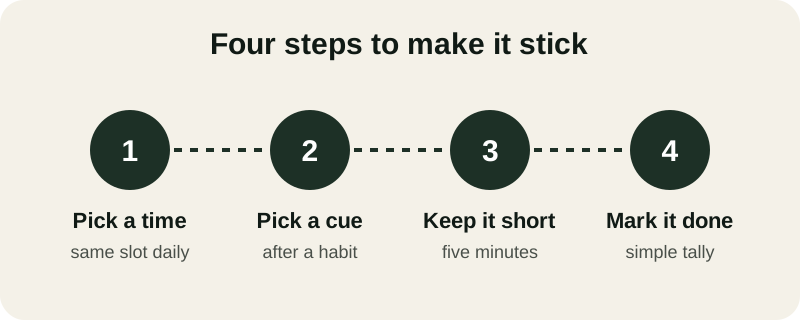
- Pick a time. Choose the same slot every day — right after breakfast, or right before bed — so your body starts to expect it.
- Pick a cue. Attach tai chi to something already fixed in your day, like finishing your coffee or putting your shoes away. The cue does the remembering for you.
- Keep it short. Five minutes you'll actually do beats twenty minutes you keep postponing. You can always stay longer once you're standing there anyway.
- Mark it done. A tick on a calendar or a simple tally gives you something to look back on, especially on the days motivation is thin.
How much tai chi is enough to stick with?
Five to 10 minutes most days is enough to build a lasting tai chi practice — far more useful than an occasional hour that leaves you too tired to repeat it the next day.
Short sessions are easier to start, easier to finish, and easier to repeat tomorrow, which is the whole point of building consistency. If you're not sure how long a session should run while you're starting out, our guide on how long a beginner tai chi session should be walks through it in more detail. And if you're wondering how often rather than how long, how often seniors should do tai chi covers a simple weekly rhythm.
Once a short session feels easy most days, you can add a minute or two, or add a second short session later in the day. Let the habit lead the length, not the other way around.
Common mistakes that break a tai chi streak
Most broken streaks come down to a handful of avoidable habits: aiming too big too soon, treating one missed day as a failure, or waiting for a "good" time instead of using the time you have.
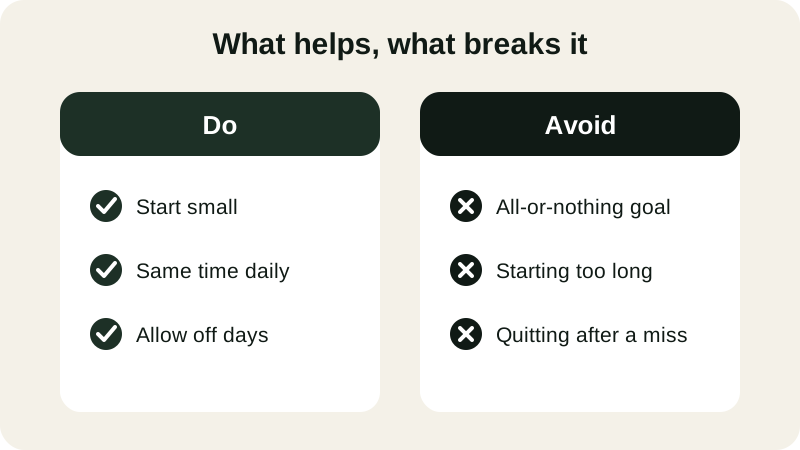
Do:
- Start small
- Same time daily
- Allow off days
Avoid:
- All-or-nothing goal
- Starting too long
- Quitting after a miss
If joint stiffness, dizziness, or balance is part of why you've hesitated to start, move gently, keep a stable chair, wall, or counter nearby, and check with a doctor first before building up your routine.
Where a guided routine fits into consistency
A lot of the habit-stacking above works whether you're following your own routine or a guided one. If you like having the next move simply shown to you, Daily Tai Chi lets you set a daily reminder at a time you choose, so the cue is handled for you rather than something you have to remember on your own.
Its 28-day path is built from short, standing sessions — a warm-up, main flow, and cool-down, with 10 to 30 moves shown one at a time, in 5, 10, 15, or 20-plus minute lengths you pick to match your day. If you'd rather set your own cue and schedule, the guide to setting a daily reminder for tai chi practice covers three simple ways to do that without any app at all. And if you're just getting your footing with the basics first, our beginner's guide to tai chi for seniors is a gentle place to start before worrying about streaks.
Keeping the habit going over the weeks
Consistency isn't about never missing a day — it's about making the next day easy to return to. Keep your cue simple, keep your sessions short enough that you never dread them, and let a tally or calendar mark show you the practice you've already built, especially on the days you're tempted to skip it.
Some weeks will feel easier than others, and that's completely normal. What matters is that tomorrow's session stays just as easy to start as today's was — same time, same cue, same short length — so the habit keeps carrying itself forward.
What if I miss a day of tai chi practice?
Missing a day won't undo your progress — just pick up again the next day at your usual time. A missed day only becomes a setback if it turns into a missed week, so the real goal is simply not missing twice in a row.
Is morning or evening better for a consistent tai chi practice?
Either works, as long as you pick one and keep it. Many people like a few quiet minutes in the morning to start the day calmly; others prefer tai chi before bed to wind down. The best time is simply the one you'll actually repeat.
Can you stay consistent with tai chi without taking a class?
Yes, many people build a steady home practice on their own, following a simple routine or a guided program at a fixed time each day. A class adds structure and company, but repetition at home, on your own schedule, works just as well.
How long before tai chi practice feels automatic?
It varies by person, but most people notice practice starting to feel automatic after a few consistent weeks, once it's attached to a fixed time and cue. Keeping sessions short in those early weeks makes the stretch easier to get through.