 DAILY TAI CHI
Tai Chi for Seniors Over 70: 4 Gentle Moves to Start
A practical, unhurried introduction to tai chi for seniors over 70, with four moves to start with, a few habits to avoid, and guidance on how long and how often to practice.
Published
Quick answer
Tai chi for seniors over 70 works well as a few slow, standing moves — weight shifts, wave hands, heel-to-toe and sit-to-stand — done 5 to 10 minutes a day near a stable chair or wall. Ease in slowly and check with a doctor first if you manage a health condition.
Key takeaways
- Start with four slow moves: weight shift, wave hands, heel-to-toe stand, sit-to-stand.
- Practice 5 to 10 minutes a day near a stable chair, wall, or counter.
- Stop if you feel dizzy or unsteady, and check with a doctor first if needed.
- Tai chi is often called meditation in motion — slow, calm, low-impact movement.
- Build up gradually; a few minutes most days beats one long weekly session.
If you're a senior well past 70 and wondering whether tai chi is still for you, the answer starts with a short, standing practice built from slow, familiar moves — weight shifts and wave hands — done for just 5 to 10 minutes at a time.
Harvard Health Publishing describes tai chi as meditation in motion, and that fits especially well once you're past 70: nothing to rush, nothing to perform, just slow movement paired with slow breath.
If you're looking for tai chi exercises for seniors over 70 that don't demand speed, strength, or flexibility, the four moves below are a good place to begin, with a couple of ways to go further once they feel familiar.
Is tai chi safe for someone over 70?

Yes, tai chi for seniors over 70 is considered a safe, low-impact way to stay active, since every move is slow and controlled rather than fast or jarring. As with any new practice later in life, it helps to ease in slowly and listen to your body.
Many people who start after 70 have never done structured exercise before, and that's perfectly fine — tai chi doesn't ask for an athletic background. You simply stand tall, feet hip-width apart, and let your weight settle before each slow movement begins.
Slow, weight-bearing movement like this also tends to feel kinder to stiff knees and hips than higher-impact exercise, since you're never pushing off hard or landing with force. That doesn't mean every move feels effortless on day one — it means you get to set the pace yourself, movement by movement.
Four slow moves that build confidence
These four movements show up in nearly every beginner tai chi session, and each one can be practiced near a stable chair, wall, or counter for extra support.
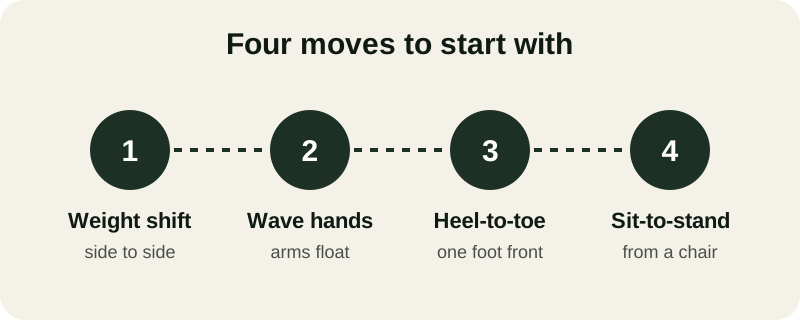
- Weight shift — side to side
- Wave hands — arms float
- Heel-to-toe — one foot front
- Sit-to-stand — from a chair
- Weight shift. Stand tall, feet hip-width apart, and slowly move your weight from one foot to the other, letting your hips sway softly side to side.
- Wave hands. Turn gently at the waist while your hands float up and across in front of you, like smoothing calm water.
- Heel-to-toe. Place one foot in front of the other, heel touching toe, and hold for a few slow breaths before swapping feet.
- Sit-to-stand. From a sturdy chair, rise slowly to standing and lower back down just as slowly, letting your legs do the work instead of momentum.
Ankle circles make a gentle warm-up before any of these, loosening the ankles before you ask them to carry your weight. Once the four moves above feel steady, a single-leg stand is worth adding — lift one foot an inch off the floor, holding your chair, and hold for a slow count of five.
Pair each move with your breath rather than a count — breathe in as you shift or rise, breathe out as you settle back. This turns four simple moves into something closer to tai chi breathing techniques than a list of exercises to get through.
What slows some people down, and what helps
A few small habits make tai chi harder than it needs to be, and a few simple adjustments fix them almost right away.
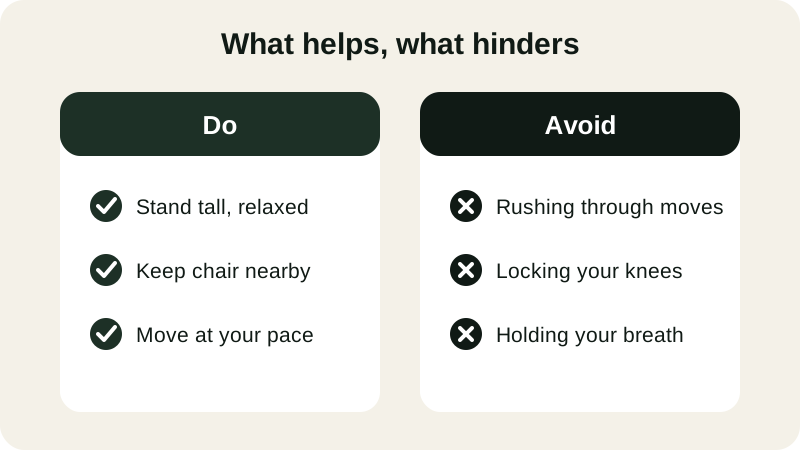
| Do | Avoid |
|---|---|
| Stand tall, relaxed | Rushing through moves |
| Keep chair nearby | Locking your knees |
| Move at your pace | Holding your breath |
Locked knees are another quiet habit worth unlearning. A soft bend in each knee gives you more give and more control, especially during weight shifts and the sit-to-stand move, where stiff joints can make balance harder to find.
Footwear matters too. Smooth socks on a slick floor can undo a careful weight shift in an instant, so flat, grippy shoes or bare feet on carpet tend to work best. A clear patch of open floor, with nothing to trip over, matters just as much as the moves themselves.
How long should you practice each day after 70?
Five to ten minutes a day is plenty when you're starting tai chi for seniors over 70 — short, consistent sessions build steadiness faster than one long session now and then. You can always add a few more minutes as the weeks go by.
If you'd rather follow along than remember the order yourself, Daily Tai Chi builds a 28-day path of short, guided sessions, each with a warm-up, main flow, and cool-down shown one move at a time. Sessions are done standing, with a chair or wall within reach, and you choose 5, 10, 15, or 20+ minutes a day. The first 4 days are free, with no card and no account needed to try it.
There's no need to rush toward a longer session either. Many people stay happily at 5 to 10 minutes for weeks before adding more, and that's a perfectly good place to stay if it fits your day. The goal is a practice you'll actually repeat tomorrow, not a longer one you'll skip.
For more on building frequency over time, our guide to how often seniors should practice tai chi breaks down a simple weekly rhythm.
Building a steady practice after 70
If balance is your main concern, tai chi for fall prevention goes deeper into weight-shifting moves like these, and balance exercises after 60 offers a few more to rotate in. Most people do best picking one quiet time each day — morning tea, or just before the evening news — rather than waiting for a free hour.
A few signs you might be ready to add a little more time:
- The four moves feel familiar, not effortful
- You're steady through each weight shift
- You look forward to practicing most days
Keep each session short enough that skipping feels like the exception rather than the rule, and let your practice grow slowly, the same unhurried way the moves themselves do.
Sources
Can you start tai chi for the first time after 70?
Yes. Tai chi is low-impact and starts with slow, standing moves like weight shifts, so no prior fitness or flexibility is needed. Begin with just a minute or two near a stable chair or wall, and add a little more time as you feel steadier on your feet.
Do you need to be flexible to try tai chi over 70?
No — tai chi doesn't require deep stretches or flexibility. Movements stay small and slow, and you can shorten any reach or turn to whatever feels comfortable right now. Flexibility often improves gradually with steady practice over the following weeks.
Is it better to practice tai chi standing or seated after 70?
It depends on your balance and energy that day. Standing near a stable chair or wall lets you shift your weight fully, while a seated version of the same slow movements works well on days you need extra support — many people alternate between the two.
What if you have arthritis, joint pain, or another health condition?
Tai chi's slow, low-impact moves are often comfortable for stiff joints, but situations vary. Keep a stable chair, wall, or counter nearby, move at whatever pace feels easy, and check with a doctor first before starting if you have a diagnosed condition.