 DAILY TAI CHI
Tai Chi for Mental Clarity and Focus: 5 Moves
Tai chi sharpens mental clarity and focus by pairing five slow, low-impact moves with steady breathing so your mind has one simple thing to follow at a time.
Published
Quick answer
Tai chi supports mental clarity and focus by pairing slow, deliberate movement with steady breathing, giving your mind one simple thing to track at a time. A short daily session of five to ten minutes is often enough to notice a calmer, more attentive mind.
Key takeaways
- Five moves — wave hands, weight shifts, heel-to-toe stand, single-leg stand, sit-to-stand — train focused attention.
- Slow breathing paired with movement gives your mind one steady thing to follow at a time.
- Short daily sessions of five to ten minutes build attention more reliably than occasional long ones.
- Keep a stable chair, wall, or counter nearby during balance moves, and stop if you feel dizzy or unsteady.
- Qigong offers a calmer, more stationary way to practice the same focused attention.
Tai chi can sharpen mental clarity and focus by training you to put your full attention on one slow movement at a time, instead of letting it scatter across a dozen things at once.
People searching for tai chi for focus and concentration often arrive here after noticing their mind wandering more than it used to, or feeling scattered by the end of a busy day. The practice offers a quiet, low-impact way to retrain that attention — no mat, no equipment, and nothing to rush.
Can tai chi really sharpen your focus?
Yes. Tai chi asks you to track your breath, your weight, and the position of your hands all at the same time, which is a gentle form of attention training. Because the pace is slow, there's room to notice when your mind drifts and bring it back — the same small skill that carries over into daily focus.
This is part of why the practice is often described as meditation in motion. Instead of sitting still to quiet the mind, you keep the body gently moving while the mind settles around it. Organizations like the National Institute on Aging and NCCIH describe tai chi this way too — slow, flowing movement combined with focused attention and steady breathing. If you'd like to understand that breathing piece more closely, our guide to Tai Chi breathing exercises for calm and focus walks through it in detail.
Five slow moves that train attention
Each of these five tai chi concentration exercises asks for a slightly different kind of attention — on balance, on rhythm, or on breath — which is part of what makes them useful for a wandering mind.
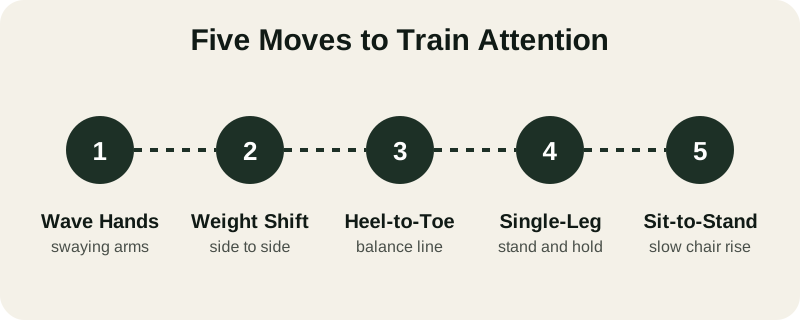
- Wave hands — stand tall, feet hip-width apart, and let your hands float and turn softly in front of you. Follow the motion with your eyes to anchor your attention.
- Gentle weight shifts — rock slowly from one foot to the other, noticing exactly where your weight settles each time.
- Heel-to-toe stand — place one foot directly in front of the other and hold, using a stable chair, wall, or counter for support.
- Single-leg stand — lift one foot a few inches off the floor and hold for a slow count, keeping your gaze steady on one spot.
- Slow sit-to-stand — rise from a chair at an unhurried pace, paying attention to how your legs and core do the work together.
You don't need all five in one sitting. Many people start with just wave hands and gentle weight shifts, then add the standing-balance moves once those feel familiar. Our tai chi standing meditation guide is a good next step if you'd like to slow things down even further.
Do and don't: keeping your mind steady during practice
As a form of mindful movement for clarity, tai chi works best when the small habits around it support rather than compete with your attention.
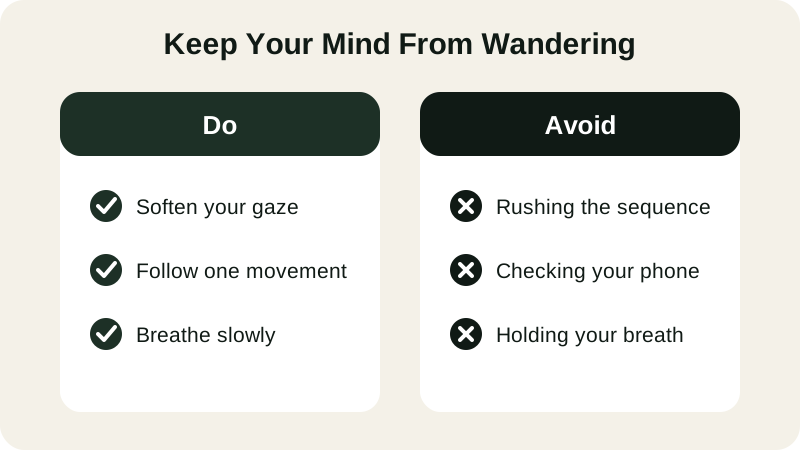
- Do: soften your gaze, follow one movement at a time, and breathe slowly.
- Avoid: rushing the sequence, checking your phone mid-session, and holding your breath.
Breath is really the quiet half of this practice. A long, slow exhale as you shift your weight or lower your hands gives your attention a steady anchor — something to come back to whenever your thoughts wander off. Think of this as attention training rather than exercise: the goal isn't to get the shape of the movement perfect, it's to notice when you've drifted and gently return.
If you'd like more structure around the breathing itself, our piece on calming the nervous system pairs well with this one, since a settled nervous system makes focused attention easier to sustain.
How much practice builds mental clarity?
Many people notice their mind settling into focus more easily after a few weeks of short daily sessions, rather than from one long occasional practice. Five to ten minutes, done consistently, tends to matter more than the length of any single session.
If standing moves feel like too much some days, a seated version works just as well for training attention — the focus comes from the attention itself, not from being upright. Our chair Tai Chi guide covers the same gentle ideas sitting down, and qigong offers an even more stationary option if you'd rather build focus through breath and posture alone before adding movement.
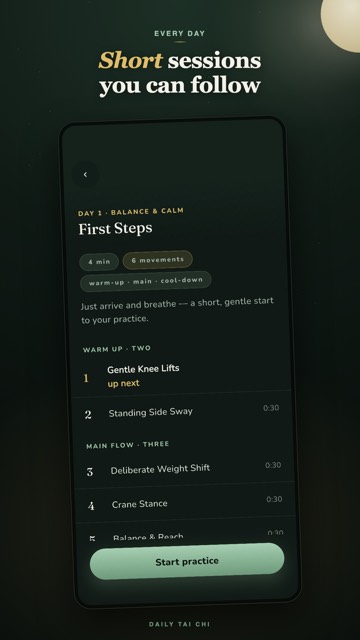
This is also where a guided structure helps. Daily Tai Chi builds a 28-day path of short, step-by-step sessions — warm-up, main flow, and cool-down — so you're not guessing at order or pace while you're trying to focus. The first four days are free, with no card and no account needed, and it runs on iPhone and Android if you'd like to try a few sessions before deciding whether it fits your routine.
Whichever pace you choose, the same simple idea carries the whole practice: one slow movement, one steady breath, one thing at a time. That's the quiet work that, over days and weeks, tends to leave the mind a little clearer.
Sources
Is tai chi better than meditation for focus?
Both train attention, just differently. Seated meditation works on stillness, while tai chi pairs that same attentive quality with gentle movement, which many people find easier to sustain. Try qigong or a seated form first if you want a calmer start, then add standing moves as you feel ready.
Can seated tai chi support mental clarity too?
Yes. The focus comes from giving one slow movement your full attention, not from standing up. A seated practice using the same wave hands and weight-shift patterns offers the same attention-training benefit for anyone managing limited mobility or balance concerns.
What time of day is best for practicing for focus?
There's no single best time. Some people find a morning session clears the mind for the day ahead, while others prefer an afternoon slot to reset focus before evening tasks. Pick a consistent time that fits your schedule, since regularity matters more than timing.
Do I need any experience to use tai chi for focus?
No prior experience is needed. The movements are slow and low-impact, so beginners and adults 55+ can start directly with gentle weight shifts and short sessions of five to ten minutes, building attention gradually rather than all at once.