 DAILY TAI CHI
Tai Chi for Memory in Seniors: Try Wave Hands Daily
Five slow tai chi moves that pair movement with attention to support memory and focus in seniors, plus guidance on how often to practice.
Published
Quick answer
Tai chi for memory in seniors works by pairing slow movement with steady attention: five simple moves, including wave hands and the heel-to-toe stand, ask your brain to track weight, breath, and sequence at once. A few minutes most days builds the habit.
Key takeaways
- Each move pairs weight shifts, breathing, and arm sequences, which keeps attention anchored.
- Five moves to start: wave hands, weight shifts, heel-to-toe stand, single-leg stand, ankle circles.
- Naming a move quietly as you do it gives memory a second hook to hold onto.
- 5 to 10 minutes most days works better than one long session for building focus.
- Keep a stable chair, wall, or counter nearby, move gently, and check with a doctor first.
Tai chi supports memory in seniors by pairing slow, deliberate movement with steady attention — each move asks you to track your weight, breath, and arms together, which works like a quiet exercise for focus.
If you've noticed more foggy mornings, or find it harder to hold a thought while reaching for your keys, a short daily practice is a gentle place to start — no equipment, no class, just a few slow minutes.
Why does tai chi support memory in seniors?
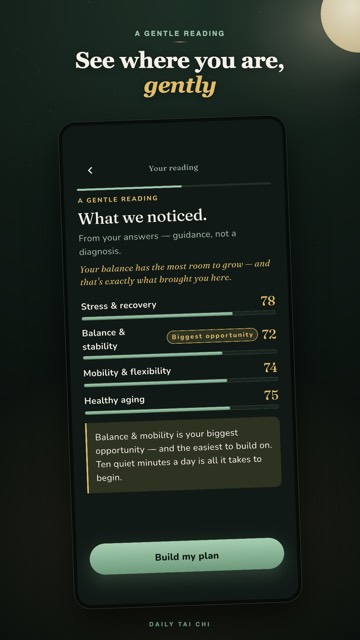
Tai chi supports memory in seniors because each movement bundles several small tasks — shifting weight, breathing slowly, and sequencing your arms — into one continuous flow. That gentle multitasking keeps your attention anchored in the present moment, the same kind of focused practice many people find sharpens recall and calms a busy mind.
Sources like Harvard Health Publishing and the National Institute on Aging write about how movement and attention are closely linked in the brain. You don't need to understand the science to benefit from it — you only need to show up, move slowly, and let your mind follow your body instead of your to-do list.
If attention and focus are your main goal, our guide to tai chi for mental clarity and focus goes further into the breathing side of this practice.
The link between slow movement and a focused mind
Tai chi isn't the only slow-movement practice that asks for this kind of attention. Qigong, its close cousin, uses even slower, breathing-led movements to build the same steady focus, and pairing the two gives your attention more than one way to practice.
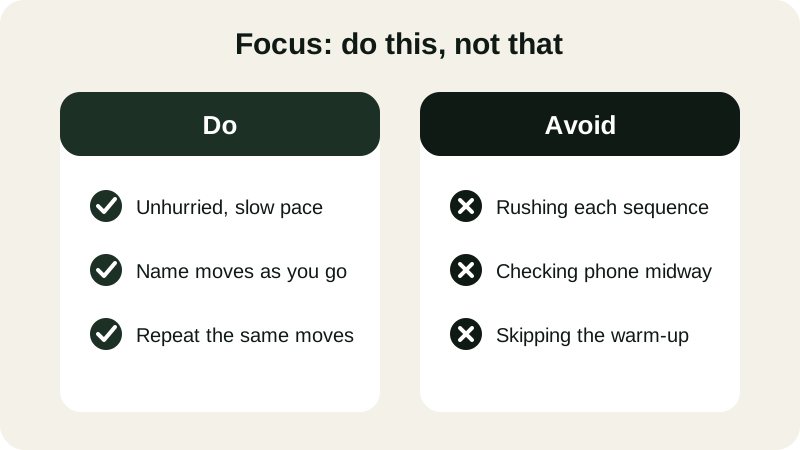
| Do | Avoid |
|---|---|
| Unhurried, slow pace | Rushing each sequence |
| Name moves as you go | Checking phone midway |
| Repeat the same moves | Skipping the warm-up |
Naming each move quietly as you do it — "wave hands," "weight shift," "ankle circles" — turns the sequence into words as well as motion. That small habit gives your memory two different hooks to hang the movement on instead of one.
For a closer look at this slower, breath-first style, see our guide to qigong for seniors and beginners.
Five slow moves to build into a memory-friendly routine
These five moves are simple enough to learn from a sentence, which is the point — you can focus on the movement and your breath instead of memorizing anything complicated.
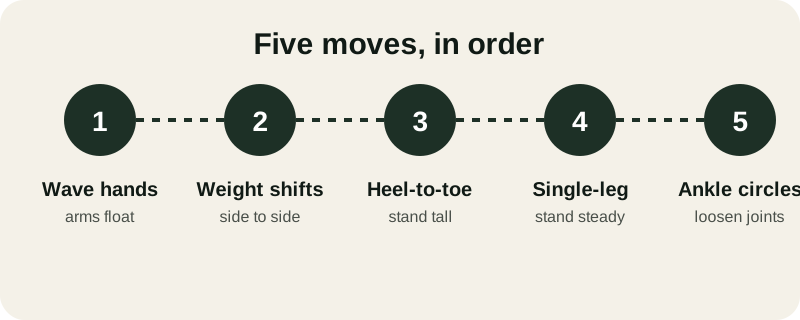
- Wave hands. Stand tall, feet hip-width apart, and let your arms float side to side like smoothing water. Your eyes follow your hands, which keeps attention moving with the motion.
- Weight shifts. Rock your weight slowly from one foot to the other, a hand resting on a stable chair, wall, or counter if you want it. Notice the shift as it happens.
- Heel-to-toe stand. Place one foot directly in front of the other and hold for a few slow breaths, then swap. This asks for quiet concentration more than strength.
- Single-leg stand. Holding support, lift one foot an inch off the floor and count slowly to five. Lower, switch sides, and let your focus settle on balance alone.
- Ankle circles. Lift one foot slightly and trace slow circles with your ankle, one direction and then the other. A small movement, done with full attention.
These same moves show up in our guide on how tai chi improves balance, since steadier footing and a steadier mind tend to arrive together.
How often should you practice for the best effect?
Most people do better with 5 to 10 minutes on most days than one long weekly session, since short, repeated practice is what keeps movement and attention paired together over time.
That small, steady rhythm matters more than intensity. A short session before coffee or after dinner is easy to repeat, and it's the repeating — not the length — that trains your attention to settle into the movement quickly each time.
If you'd like a hand keeping the sequence simple, Daily Tai Chi builds a 28-day path of short, guided sessions — a warm-up, main flow, and cool-down — with each move shown one at a time alongside spoken cues and a short video clip, so you're never holding more than one movement in mind at once. You pick 5, 10, 15, or 20+ minutes a day, the first 4 days are free with no card and no account, and it runs on iPhone and Android.
For a fuller weekly plan, our guide on how often seniors should do tai chi breaks this down week by week.
Sources
Does tai chi actually improve memory, or just mood?
Tai chi hasn't been shown to reverse memory loss on its own, but the slow, attention-heavy movement is widely discussed by sources like NCCIH and MedlinePlus as a way to support focus and mood alongside everyday movement. Pair it with other mentally engaging habits for the broadest benefit.
Can tai chi help if memory changes are related to Parkinson's?
That depends on your specific situation, so check with a doctor first. Organizations such as the Parkinson's Foundation offer guidance on exercise and Parkinson's specifically; tai chi's slow, balance-focused movement can be an addition to whatever plan your care team already recommends.
Is tai chi better than crossword puzzles or brain games for memory?
They work differently: puzzles train a seated, verbal kind of focus, while tai chi adds movement, balance, and breath to the mix. Rather than choosing one, many people get the most out of using both — a few minutes of movement and a few minutes of a puzzle each day.
How soon might you notice a difference in focus?
It depends on how often you practice and where you're starting from, so there's no single week to expect it by. Many people notice feeling calmer and more focused within the first few weeks of practicing a few minutes most days; staying consistent matters more than any one session.