 DAILY TAI CHI
Tai Chi for Heavy Sleepers: Wave Hands Wake-Up in 5 Minutes
A slow, four-move tai chi wake-up — ankle circles, weight shifts, wave hands, and a heel-to-toe stand — helps heavy sleepers ease out of deep sleep instead of jolting awake.
Published
Quick answer
Tai chi for heavy sleepers works best as a slow, standing wake-up routine rather than a jolt: a few minutes of ankle circles, weight shifts, and wave hands right after waking ease your body out of deep sleep at its own pace.
Key takeaways
- Heavy sleepers wake from deep sleep, which can leave a lingering fog known as sleep inertia.
- A slow routine of 5 to 10 minutes eases you into the day instead of forcing a sudden jolt.
- Wave hands and gentle weight shifts are a kind way to start moving before coffee or chores.
- Ankle circles and a heel-to-toe stand wake up circulation while you're still half-asleep.
- Keep a stable chair, wall, or counter nearby if you feel unsteady first thing in the morning.
Tai chi for heavy sleepers works best as a slow, standing routine you move through right after waking — not a jolt to get your heart racing. A few easy minutes of wave hands and weight shifts let you leave deep sleep at your own pace instead of all at once.
Why heavy sleepers wake up feeling groggy

If you're a heavy sleeper, you likely spend more time in deep sleep stages than light sleepers do, and waking out of that stage can leave you feeling foggy for a while — a lag sometimes called sleep inertia. An alarm that pulls you upright in one motion doesn't fix that fog; it just asks your body to catch up fast, which is exactly when a stumble toward the bathroom or kitchen is most likely.
A slower transition gives your nervous system time to come online instead of being rushed. That's where a short, tai chi-style routine fits naturally into the first minutes of the day, well before coffee, a shower, or anything that asks you to be fully alert.
This matters whether you've always slept deeply or have just noticed it more as you've gotten older. Either way, the goal isn't to force yourself awake faster — it's to give your body a kinder on-ramp. Some mornings that fog lifts in a minute or two; other mornings it lingers through the first cup of coffee. A slow routine doesn't erase that variation, but it gives you something steady to lean on while your body finds its footing.
What a slow tai chi routine does differently
Instead of asking your body to snap awake all at once, a slow routine asks it to wake up one small motion at a time — turning the ankles, shifting weight, letting the arms float.
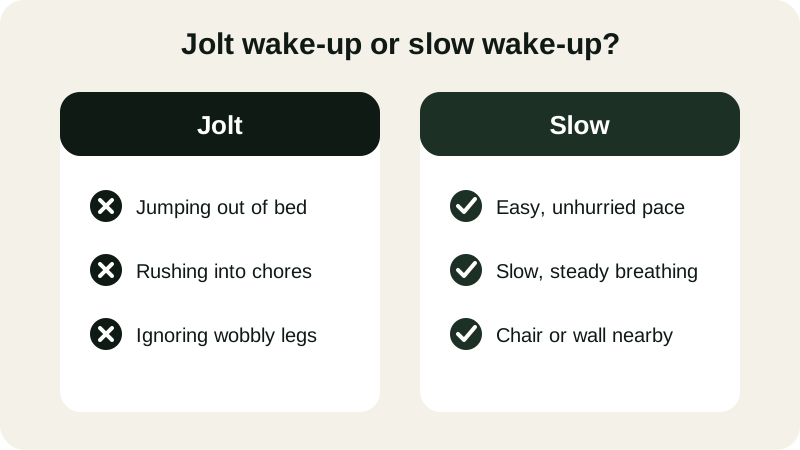
- Jolt: jumping out of bed
- Jolt: rushing into chores
- Jolt: ignoring wobbly legs
- Slow: easy, unhurried pace
- Slow: slow, steady breathing
- Slow: chair or wall nearby
Notice that neither column has anything to do with speed of movement — it's about how abruptly you ask your body to switch states. A heavy sleeper's body is already working to catch up with the day; a slow routine simply removes one more demand from that process, rather than adding to it.
What moves make a good heavy-sleeper wake-up routine?
Four slow moves done in order — ankle circles, gentle weight shifts, wave hands, and a heel-to-toe stand — give your body a gradual path from bed to the rest of the morning.
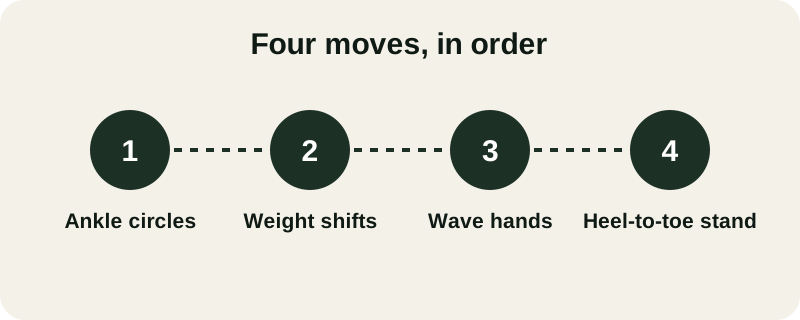
- Ankle circles. Seated or standing, circle each foot slowly a few times in both directions.
- Gentle weight shifts. Stand tall, feet hip-width apart, and rock your weight slowly from one foot to the other.
- Wave hands. Let your arms float and turn softly in front of you as you shift your weight side to side.
- Heel-to-toe stand. Place one foot directly in front of the other, heel to toe, and hold near a wall or counter for a few slow breaths.
None of this needs to look graceful. The point is simply to move slowly enough that the rest of your body can catch up to being awake. If a move feels like too much on a particular morning, shorten it rather than skip the whole sequence — even one slow pass through ankle circles and weight shifts is better than none, and you can always add the rest once you feel a little steadier.
How long should you practice each morning?
Five to ten minutes is plenty for a heavy-sleeper wake-up routine — enough to shift from foggy to alert without turning your morning into a workout.
Some mornings you might only manage the ankle circles and one weight shift before the day pulls you forward, and that's still worthwhile. On slower mornings, add a few more weight shifts, linger with wave hands, or hold the heel-to-toe stand a little longer on each side.
If you'd rather follow along than remember the order yourself, Daily Tai Chi builds a short guided session around a warm-up, main flow, and cool-down, with the length set to whatever you choose that morning — 5, 10, 15, or 20-plus minutes — and a daily reminder at a time you pick, so the routine is waiting for you rather than something you have to plan from scratch.
Building this into a habit you'll keep
A wake-up routine only helps if it's still happening a month from now, so tie it to something you already do without thinking — before you open the curtains, before the kettle goes on, before you check your phone. Anchoring a new habit to an old one tends to stick better than relying on willpower alone, especially on the mornings when the fog is thickest and motivation is lowest.
It also helps to keep the bar low on hard mornings. Four slow moves in five minutes counts as a full session; you don't need to add more just because you had time once. Our guide on staying consistent with a tai chi practice has more ways to keep a short routine going without it turning into one more chore.
Pairing a morning routine with better evenings
How you sleep at night shapes how groggy you feel at wake-up, so a slow wind-down before bed is worth pairing with your morning routine. Our guide to tai chi for sleep walks through a calm evening sequence, and four moves for sleep quality covers simple options to try before lights out.
For more ideas at the other end of the day, see our tai chi for morning energy guide, or try the 5-minute morning routine if you'd like something ready-made to follow tomorrow. Either way, the aim is the same: let your body wake up in its own time, not all at once.
Is it bad to stay in bed a few extra minutes before moving?
No — sitting up slowly on the edge of the bed for a minute, feet flat on the floor, is a fine first step. It gives your body a moment to register that you're awake before you ask it to stand, shift weight, or balance on one foot.
Can this wake-up routine be done sitting on the edge of the bed?
The standing moves described here work best on your feet, but many of the same slow, flowing ideas adapt to sitting. Our chair tai chi guide walks through a fully seated version you can follow if standing first thing doesn't feel right yet.
Will a morning tai chi routine stop you from feeling groggy every day?
It won't erase grogginess entirely — that depends on your sleep stages, sleep length, and other habits. What it can do is give you a gentler, steadier transition out of deep sleep than snapping straight to a loud alarm and a fast stand-up.
What if you feel dizzy or unsteady during the moves?
Stop the move, sit down if you can, and wait for the feeling to pass. Move gently, keep a stable chair, wall, or counter nearby for every session, and check with a doctor first if dizziness on waking happens often.
Does it matter what time of day you try this besides morning?
No single time is required — many heavy sleepers find mornings most useful because that's when grogginess peaks, but the same slow moves work as a midday reset or a quiet pause before an evening routine, whenever your body needs one.