 DAILY TAI CHI
Tai Chi for Feeling Grounded: Try the Rooting Stance
This article explains how four slow tai chi moves — gentle weight shifts, wave hands, a heel-to-toe stand, and a single-leg stand — help beginners and older adults feel grounded, steady, and calm in just five to ten minutes a day.
Published
Quick answer
Tai chi for feeling grounded works through slow weight shifts, wave hands, and a heel-to-toe stand that train your feet and attention to settle. Five to ten minutes a day near a stable chair or wall is usually enough to notice steadier, calmer footing within a week or two.
Key takeaways
- Slow weight shifts train your feet and ankles to sense the floor beneath you.
- Wave hands keeps your knees soft and your breath even while you move.
- A heel-to-toe stand and single-leg stand build steadiness over a week or two.
- Five to ten minutes a day, done standing, is enough to notice a grounded feeling.
- Keep a stable chair, wall, or counter nearby if your balance feels shaky.
Feeling grounded during tai chi comes from a handful of slow, specific moves, not from mastering a whole form. This article walks through what that settled feeling is, four moves that build it, and how long it usually takes to notice.
If you have felt rushed, scattered, or a little unsteady on your feet lately, this is the kind of practice that asks you to slow down on purpose — and lets your body catch up with your mind.
What does it mean to feel grounded in tai chi?
Feeling grounded in tai chi means your weight settles fully into your feet, your knees stay soft, and your mind stops racing ahead of your body. It comes from slow weight shifts and even breathing, not any special skill, and many people notice it within their first few sessions.
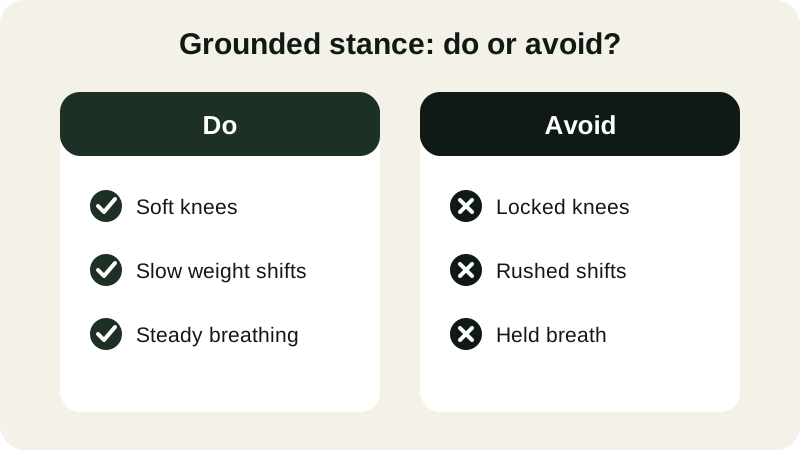
- Do: soft knees
- Do: slow weight shifts
- Do: steady breathing
- Avoid: locked knees
- Avoid: rushed shifts
- Avoid: held breath
This settled feeling has a name in tai chi: a rooting stance. Imagine roots growing from the soles of your feet down into the floor, holding you steady no matter how your arms and shoulders move above. You do not need good balance to start — you need a few unhurried minutes and a willingness to move slower than feels natural at first.
Many people come to this practice after noticing shakier balance, stiffer joints, or a general sense of being scattered through a stressful stretch of life. None of that disqualifies you from feeling grounded quickly. Tai chi was built for exactly this starting point, with movements slow enough that your body never has to rush to keep up with your mind.
Four moves that build a feeling of being grounded
These four moves, done slowly and roughly in this order, are a simple way to practice feeling grounded at home. Each one asks you to notice your feet and settle your weight before you move any further.
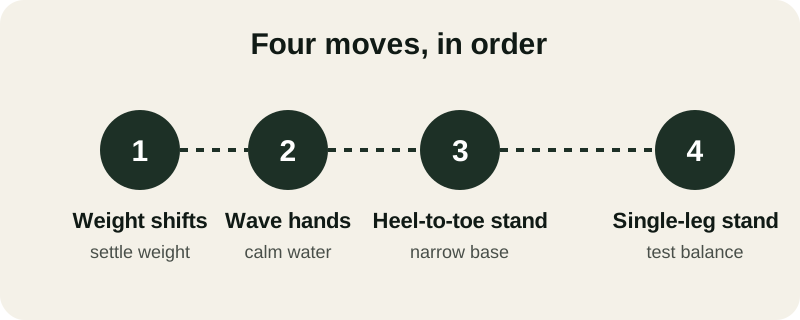
- Gentle weight shifts. Stand tall, feet hip-width apart, with a hand resting near a stable chair, wall, or counter. Slowly move your weight onto your right foot, pause, then glide it back to the left. Repeat ten times on each side.
- Wave hands. Keep shifting your weight side to side while your hands float and turn softly in front of you, like smoothing the surface of calm water. This links the settled feeling in your feet to relaxed motion in your arms.
- Heel-to-toe stand. Place one foot directly in front of the other, heel touching toe, as if standing on a line. Hold your support, find your balance, and breathe slowly for a few breaths before swapping feet.
- Single-leg stand. Holding your chair, lift one foot an inch or two off the floor and hold for a slow count. Lower, switch sides, and notice how your standing leg roots into the floor beneath you.
You do not have to do all four moves every day, and you do not have to do them perfectly. Some days you might only have time for weight shifts and wave hands; other days you might add the heel-to-toe stand and single-leg stand once you feel warmed up. The order matters less than the slowness — rushing any of these moves undoes the grounded feeling you are practicing for.
How long do you need to practice to feel it?
Five to ten minutes a day is usually enough to notice a grounded feeling, especially if you practice around the same time each day. Some people feel steadier after a single session, while for most the settled feeling builds gradually over a week or two of short, consistent practice.
What you notice first is rarely dramatic — it is small things. Your feet feel more like they belong to the floor. Your shoulders drop an inch without you trying. Your breath slows down on its own instead of you having to force it. These small signals are the grounded feeling settling in, and they tend to arrive before any big changes in flexibility or strength.
If you would like a structure to follow rather than piecing moves together yourself, the app guides you through a 28-day path of short standing sessions, each built from a warm-up, main flow, and cool-down, with 10 to 30 moves shown one at a time so you always know what comes next. You choose 5, 10, 15, or 20+ minutes a day, and the first 4 days are free, with no card and no account needed to start.
Making a grounded feeling part of your day
A grounded feeling does not need a formal session to show up. Pause for one slow weight shift while the kettle boils, or stand tall with feet hip-width apart before you answer the phone. These small habits carry into the rest of your day once your body has practiced them enough times to trust them.
Grounding can fit into different pockets of your day, depending on what you need from it most:
| Time of day | What grounding offers |
|---|---|
| Morning | Settles a stiff or hurried start before the day speeds up |
| Midday | A short reset between tasks, standing at a desk or kitchen counter |
| Evening | Slows a racing mind before the day's last tasks or before bed |
If steady footing is really the goal here, our guide to how tai chi improves balance builds on these same ideas in more depth. And if you would like one move to return to whenever a day feels scattered, our piece on tai chi standing meditation walks through a short stillness practice that many people describe as the most grounding part of their day.
Tai chi is not the only slow practice built around this kind of centering. If you are curious how it compares with its close cousin, our explainer on the difference between qigong and tai chi is a good next read, especially if standing stillness appeals to you more than moving through a sequence.
However you arrive at it, a grounded feeling is less about reaching a fixed pose and more about returning, often, to the same slow attention to your feet and your breath. That is really the whole practice.
Sources
Does a grounded feeling in tai chi relate to balance?
Yes, the two are closely linked. The same slow weight shifts and steady stance that create a grounded feeling also train the small muscles that keep you steady on your feet, so improved balance is often one of the first things people notice.
Is a rooting stance the same thing as qigong?
Not quite. Tai chi's rooting stance is a moving practice built around slow steps and shifting weight, while qigong often holds a single standing posture for longer stretches. Both train the same settled, grounded feeling through breath and stillness.
What if standing still makes you feel unsteady?
Keep a stable chair, wall, or counter within reach, and shorten how long you hold each position. If standing itself feels too wobbly some days, practicing the same weight-shift ideas seated is a reasonable way to keep building the habit.
Do you need bare feet to feel grounded?
No special footwear is required. Flat, flexible shoes or bare feet both let you feel the floor and shift weight naturally; what matters more is keeping your knees soft and letting your weight settle fully into each step before you move again.