 DAILY TAI CHI
App to Practice Tai Chi for Neck Pain: 4 Moves to Try
This article explains what to look for in an app to practice tai chi for neck pain, walks through four low-impact moves, and shows how a guided 28-day path can fit a short daily routine.
Published
Quick answer
An app to practice tai chi for neck pain should offer slow, guided neck and shoulder moves you can follow standing, in short sessions of about 5 to 10 minutes. Keep a stable chair or wall nearby and move at a comfortable pace.
Key takeaways
- Look for slow, guided neck and shoulder moves, not fast stretches
- Short sessions of 5 to 10 minutes suit a stiff, achy neck best
- Keep a stable chair or wall nearby and stop if you feel dizzy
- Wave hands and gentle weight shifts ease tension through the shoulders too
- Check with a doctor first if neck pain is new, sharp, or lingering
An app to practice tai chi for neck pain works best when it pairs slow, low-impact neck and shoulder moves with short guided sessions you repeat daily, rather than leaving you to guess at pace or form on your own.
If your neck has grown stiffer over the years, or tension settles into your shoulders by the end of the day, a slow, follow-along practice can feel like a relief rather than one more chore. This article walks through what to look for in a guided routine, four moves worth trying, and how a daily program can fit around them.
What should an app for neck pain tai chi actually do?
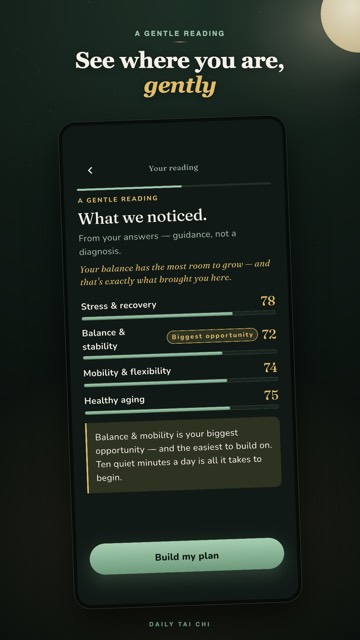
A good app for neck pain tai chi should slow you down rather than speed you up — clear spoken instructions, one move shown at a time, and a pace you control instead of a fast video you're chasing.
Beyond pace, look for sessions built around a full arc: a warm-up that loosens the neck and shoulders before anything else, a main flow of slow, flowing moves, and a cool-down that brings your breathing back to rest. Jumping straight into a demanding sequence rarely feels good on a stiff neck. Easing in and easing out matters almost as much as the moves themselves, since cold muscles are the ones that tend to protest.
It also helps if the moves adapt to how you're feeling that day. A smaller head turn, a shorter hold, a shallower reach — all of that should be fine, because the goal is comfort, not a fixed range of motion.
Finally, look for an experience that lets you pause mid-move and repeat a cue without losing your place, rather than a continuous video you have to scrub back through to find where you were.
Four low-impact moves that ease neck tension
These four moves work the neck and shoulders slowly, in a small, comfortable range, and each one can be practiced standing or seated.
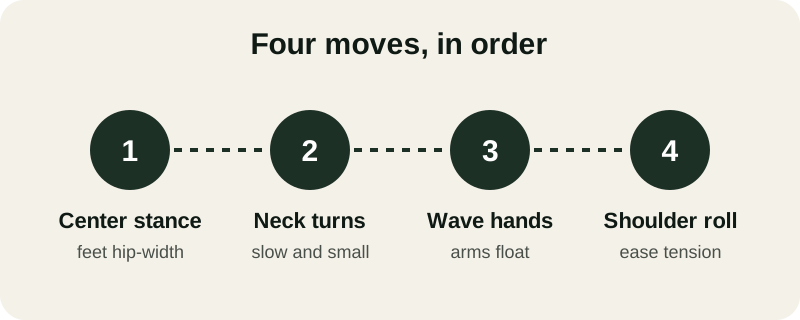
- Center your stance. Stand tall, feet hip-width apart, knees soft, shoulders dropped away from your ears.
- Slow neck turns. Turn your head gently toward one shoulder, pause, then turn toward the other. Keep the motion small and unhurried.
- Wave hands. Let your arms float side to side at chest height while your shoulders stay loose — this classic tai chi move carries tension out through the arms.
- Shoulder roll finish. Roll your shoulders back and down a few times, then let your arms rest and take a slow breath.
Practiced in this order, each move loosens the area the next one relies on — a settled stance makes the neck turns steadier, and the neck turns make the shoulder roll feel looser rather than forced. For a deeper look at these and related movements, our guide to tai chi for neck tension relief walks through each one in more detail.
Is there an app that guides you through these moves at home?
Yes. Daily Tai Chi builds a 28-day path of guided sessions, with each move shown one at a time alongside spoken cues and a short video clip, so you can follow along without memorizing a sequence.
Sessions run 5, 10, 15 or 20+ minutes, whichever suits your day, and each one strings together 10 to 30 moves across a warm-up, main flow and cool-down. The first 4 days are free, with no card and no account needed, on iPhone and Android, and you can set a daily reminder at a time you choose so practice becomes part of your routine rather than something you have to remember.
A couple of practical notes before you start: sessions are done standing, with a stable chair, wall, or counter nearby for support, rather than a seated format. The app sends anonymous usage and crash statistics, and unlocking a locked day further along the path involves an optional ad rather than a purchase.
Setting up your space and session length
You don't need much room for any of this — just enough space to stand with your arms out to the sides and a stable chair, wall, or counter within reach.
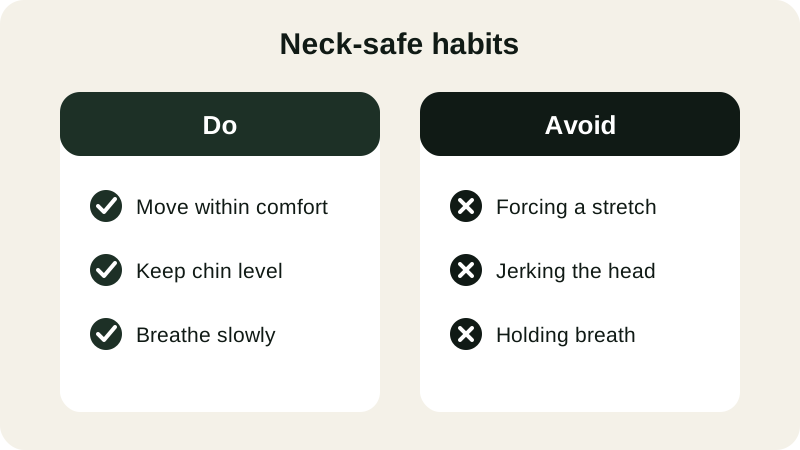
- Do: move within a comfortable range.
- Do: keep your chin level and relaxed.
- Do: breathe slowly through each turn.
- Avoid: forcing a deeper stretch.
- Avoid: jerking the head side to side.
- Avoid: holding your breath.
A session of 5 to 10 minutes most days tends to do more for a stiff neck than one long session once a week — the body seems to prefer small, repeated doses of gentle movement over an occasional big push. If you'd rather start fully seated, our chair tai chi guide covers the same slow movements from a chair, and our warm-up exercises are a good way to loosen up before any routine.
Building this into the rest of your week
A stiff neck rarely loosens from one session alone — it responds better to a steady, unhurried rhythm you can keep up over weeks. Pick a time of day that already exists in your routine, such as right after your morning coffee or just before bed, and let the same few minutes of movement sit there every day.
If you miss a day, simply pick back up the next one rather than starting over from scratch. For more ideas on keeping a routine going once the first few weeks feel easy, our guide on staying consistent with a tai chi practice and our overview of how often to practice are both worth a read.
Is there an app built specifically for tai chi and neck pain?
Daily Tai Chi isn't built only for neck pain, but its 28-day path includes guided standing sessions with moves like wave hands and gentle weight shifts that work through the neck and shoulders. Sessions run 5, 10, 15 or 20+ minutes, with the first 4 days free and no card needed.
Can you do these tai chi neck exercises while sitting down?
Yes. Many neck and shoulder moves adapt well to a chair — sit tall, feet flat, and move slowly through the same small ranges. App sessions are done standing with a chair or wall nearby for support, so for a fully seated routine, follow our chair tai chi guide instead.
How often should you practice tai chi for a stiff neck?
Most people do well with 5 to 10 minutes most days rather than one long session a week. Short, frequent practice lets the neck and shoulders loosen gradually, and you can build toward longer sessions once the movements start to feel easy.
What if slow neck turns make you feel dizzy?
Stop the movement and rest a hand on a stable chair, wall, or counter until the dizziness passes, then try a smaller range next time. Check with a doctor first if dizziness continues or if your neck pain followed a fall or other injury.