 DAILY TAI CHI
4 Moves to Practice Tai Chi for Better Posture, App-Guided
This guide explains how a 28-day guided app pairs wave hands, weight shifts, and balance moves to help beginners practice tai chi for better posture in just 5 to 10 minutes a day.
Published
Quick answer
The best app to practice tai chi for better posture guides you through slow standing moves like wave hands and gentle weight shifts in short daily sessions. Five to ten minutes with a stable chair nearby is enough to start.
Key takeaways
- Wave hands and gentle weight shifts retrain the spine to stand taller.
- Five to ten minutes a day is enough to start feeling a straighter stance.
- Heel-to-toe and single-leg stands build the quiet balance posture needs.
- Keep a stable chair, wall, or counter nearby for support.
- Stop and check with a doctor first if you feel dizzy or unsteady.
Practicing tai chi for better posture starts with slow, standing moves — like wave hands and gentle weight shifts — that retrain your spine, shoulders, and core to hold themselves taller without much effort. A short routine you repeat most days turns that retraining into a habit instead of a one-time stretch.
How does tai chi actually improve posture?
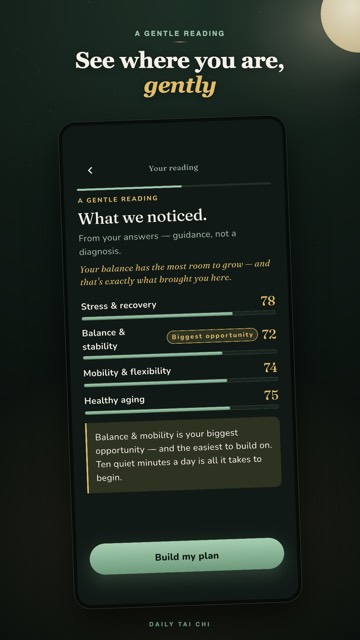
Tai chi improves posture by training body awareness and muscle control together. Each slow move asks you to notice where your head, shoulders, and hips are, then correct them — stacking the spine, softening locked knees, and drawing the chin back level. Repeated daily, that correction slowly becomes your default stance.
Unlike a quick check in the mirror, tai chi builds this awareness into movement itself. You stand tall, feet hip-width apart, and shift your weight from side to side while keeping your spine long, breathing slowly the whole time. Over several weeks, many people notice they stand a little taller without having to think about it.
Years of sitting at tables, screens, or steering wheels tend to pull the shoulders forward and curl the upper back. Tai chi works in the opposite direction, one slow repetition at a time — there's no need to force a big stretch, just quiet, repeated correction, practiced standing with a stable chair, wall, or counter nearby if you'd like the support.
Four moves that retrain alignment
These four moves show up constantly in tai chi and qigong practice, and each one targets a different part of posture — shoulders, spine, core, and balance. Practice them slowly, in the order below, and you'll feel why they're taught together.
The order matters a little: shoulders loosen first, then the spine learns to stack over a shifting base, then the core learns to hold that line, and finally balance ties it all together on one leg.
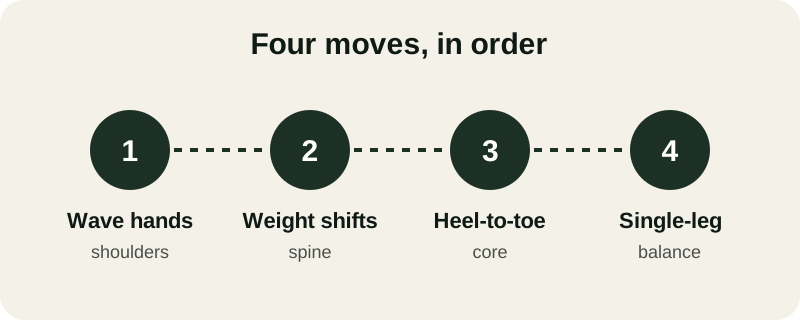
- Wave hands opens the chest and loosens rounded shoulders.
- Weight shifts align the spine over the hips as you move side to side.
- Heel-to-toe stand trains the core to hold an upright line.
- Single-leg stand builds the quiet strength that keeps posture steady, not stiff.
Wave hands
Stand tall, feet hip-width apart, knees soft. Turn gently at the waist while your hands float from side to side at chest height, palms soft and relaxed. This opens the chest and draws rounded shoulders back without any pulling or strain.
Weight shifts
Rock your weight slowly from one foot to the other, letting your spine stay long and your hips level as you move. This teaches the body to carry weight evenly instead of leaning into one hip, which is a common habit behind a tilted stance.
Heel-to-toe stand
Place one foot directly in front of the other, heel touching toe, near a stable chair, wall, or counter. Holding this line asks your core and back to work quietly together to keep you upright, rather than letting the shoulders do the balancing.
Single-leg stand
Holding a chair for support, lift one foot a few inches off the floor and notice how your standing leg, hip, and spine line up to keep you steady. This small moment of balance carries over into how you stand for the rest of the day.
For a closer look at how each of these moves targets posture, our guide to tai chi for posture improvement breaks down the cues for each one in more detail. Posture and balance also go hand in hand — a tall, even stance is part of what keeps you steady on your feet, which is covered from that angle in our guide on how tai chi improves balance.
Is there a guided app that walks you through this at home?
Yes — Daily Tai Chi offers a 28-day path of short guided sessions, each with a warm-up, main flow, and cool-down shown one move at a time with spoken cues. You choose 5, 10, 15 or 20+ minutes a day and practice standing, with a chair, wall, or counter within reach.
The first 4 days are free, with no card and no account needed, so you can try a few sessions of wave hands and weight shifts before deciding if the slow pace fits your mornings. The app works on iPhone and Android, sends anonymous usage and crash statistics, and includes an optional ad to unlock a locked day. You can also set a daily reminder at a time you choose, which helps posture work become part of your morning instead of something you have to remember.
Each move appears one at a time with spoken cues and a short video clip, so you're never guessing whether your feet or hands are in the right place mid-session. If you'd like to see how a full day is laid out, move by move, our guide to learning tai chi moves step by step walks through a typical session.
Building a short posture practice into your day
A posture practice works best when it's short, repeatable, and doesn't ask much of your morning. Five to ten minutes near a stable chair, wall, or counter is enough to work through the four moves above at an unhurried pace.
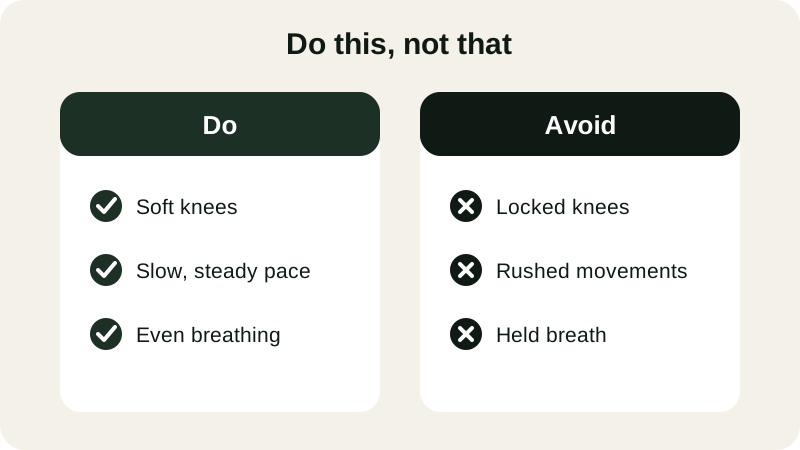
- Do: keep soft knees, move at a slow, steady pace, and breathe evenly.
- Avoid: locked knees, rushed movements, and held breath.
Breath matters here too. A slow, even inhale and exhale keeps your ribcage lifted without stiffening the shoulders — our tai chi breathing exercises guide pairs well with these posture moves if you'd like to slow the breath down further.
Consistency does more for posture than intensity. A short five-minute round most days beats one long session on a Sunday — the same idea behind building any tai chi practice that sticks.
Over a few weeks, the posture cues from your practice start to show up elsewhere — standing in line, washing dishes, sitting at a table. That carryover, not any single session, is what actually changes how you stand, far more than how any one session feels while you're in it.
Sources
Which tai chi move helps most with rounded shoulders?
Wave hands tends to help most with rounded shoulders, since the slow side-to-side turn opens the chest and draws the shoulder blades gently back. Pair it with a few weight shifts so the correction carries through your whole upper body, not just your arms.
How soon might you notice straighter posture?
There's no fixed timeline — it depends on how often you practice and how rounded your starting posture is. Many people notice a subtle difference, like less effort to stand tall, within a few weeks of five to ten minutes most days; others take longer, and that's completely normal.
What helps most with a forward head position?
Forward head posture often eases when you bring the chin level rather than jutting it forward, while keeping the back of the neck long. Many tai chi moves cue this same adjustment on every turn, so a few slow weight shifts practiced daily can help the habit stick throughout the day.
Does the app offer a seated posture routine?
No — app sessions are done standing, with a chair, wall, or counter within reach, and there's no seated version of its sessions or moves. If sitting suits you better, the site's chair tai chi guide covers the same long-spine, level-shoulder cues from a chair instead.
Do you need any equipment to start?
No special equipment is needed — just enough space to turn and shift your weight, flat or bare feet, and a stable chair, wall, or counter nearby in case you need to steady yourself. Loose, comfortable clothing makes the slow turns easier too.