 DAILY TAI CHI
App to Practice Qigong at Home: 28 Days of Sessions
This article explains what to look for in an app to practice qigong at home, five moves worth repeating, and how long and how often sessions should run.
Published
Quick answer
A good app to practice qigong at home offers short guided sessions, clear on-screen instructions, and a seated option, so you can follow along for 5 to 10 minutes without special equipment.
Key takeaways
- Qigong at home works well in 5 to 10 minute sessions, most days of the week.
- Look for large screens, slow pacing, and a seated option when choosing a program.
- Wave hands, weight shifts, and ankle circles are common qigong warm-up moves.
- Qigong and tai chi share the same slow, breath-led style of movement.
- Keep a stable chair, wall, or counter nearby for balance support.
If you want to practice qigong at home, the right app turns a few quiet minutes into a complete routine you can follow from a chair or a clear patch of floor. No studio, no commute, and no experience required — just your phone or tablet and a few minutes of quiet space.
This guide looks at what to look for in an app for home qigong practice, five moves worth repeating, and how long a session should last once you've found your rhythm. We'll also cover a few common mistakes that make solo practice harder than it needs to be, so your first weeks feel steady rather than confusing.
What makes a good app to practice qigong at home?
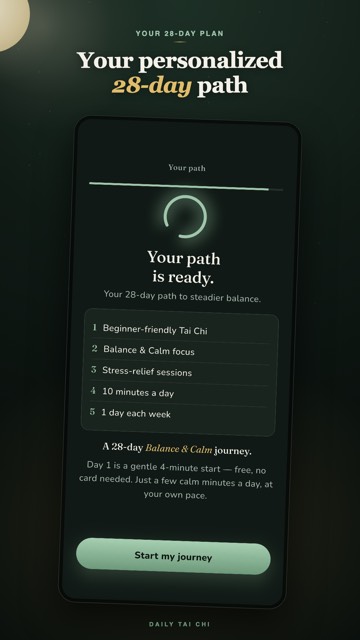
A good app to practice qigong at home offers short, guided sequences with slow pacing, large on-screen instructions, and a seated option for days when standing feels like too much. It should build gradually, adding one new movement at a time rather than starting you off with a long, complicated routine.
- Slow, spoken guidance so you can keep your eyes closed or look away from the screen.
- Large, clear visuals that are easy to follow without squinting.
- A seated version of every movement, for days when balance feels less certain.
- A gradual structure that adds a little each day instead of overwhelming you on day one.
Many people start looking for this kind of app after noticing that online videos move too quickly, or that a weekly class schedule doesn't fit their own routine. An app that lives on your phone solves both problems at once: you choose the time of day, and the pace waits for you rather than the other way around.
Daily Tai Chi builds this kind of structure into a 28-day path of short guided sessions, each one made of a warm-up, a main flow, and a cool-down that you follow right on your phone or tablet. The first 4 days are free, with no card and no account needed, so you can try a handful of sessions on iPhone and Android before deciding whether the pace suits you.
If you're curious how the two practices relate, our guide to the difference between qigong and tai chi explains the overlap, and our qigong for seniors and beginners guide is a good place to start if this is all new to you.
Five qigong moves worth practicing on repeat
These five moves show up in almost every qigong and tai chi session, and each one adapts easily to standing or seated practice.
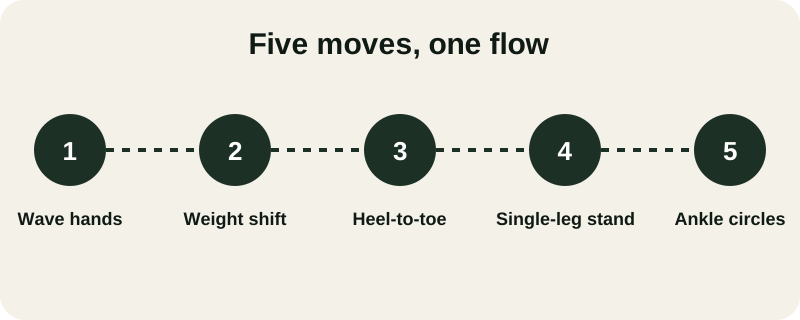
- Wave hands — let your arms float side to side, as if smoothing the surface of calm water.
- Weight shift — stand tall, feet hip-width apart, and rock slowly from one foot to the other.
- Heel-to-toe — place one foot directly in front of the other, like standing on a line, and hold.
- Single-leg stand — lift one foot just an inch off the floor while holding a chair for support.
- Ankle circles — slow, small circles at the ankle to loosen a stiff joint before you stand.
You don't need to master all five right away. Many home routines introduce one move each day during the first week, then link two or three together once they start to feel familiar. Repeating the same small set of moves is part of what makes this kind of practice calming — your body learns the pattern, and your mind is free to settle into the breath instead of trying to remember what comes next.
How long should a home qigong session last?
Most people do well with 5 to 10 minutes of qigong at home, repeated most days rather than saved for one long weekly session. Short, frequent practice builds the habit faster than an occasional hour ever could.
A 5-minute routine works nicely first thing in the morning, while a slightly longer session suits an afternoon reset or a slower evening wind-down. If you'd like ready-made options at either length, our 5-minute morning routine and our 10-minute routine for seniors both use the same slow, breath-led style as qigong, so either one works as a substitute on a day when you want some variety.
What matters more than the clock is whether you come back the next day. A short session you actually finish beats a long one you keep postponing. If ten minutes feels like plenty some days and five feels like enough on others, both are fine — the goal is consistency, not a fixed number on a timer.
If you miss a day, simply pick back up the next one. A missed session doesn't undo the ones that came before it, and there's no need to double up or make up for lost time. This kind of practice responds well to a relaxed, forgiving routine — one where you show up when you can and let go of the days you can't.
Mistakes that make solo qigong practice harder
Practicing alone from a screen is convenient, but a few habits can make early sessions feel harder than they need to be.
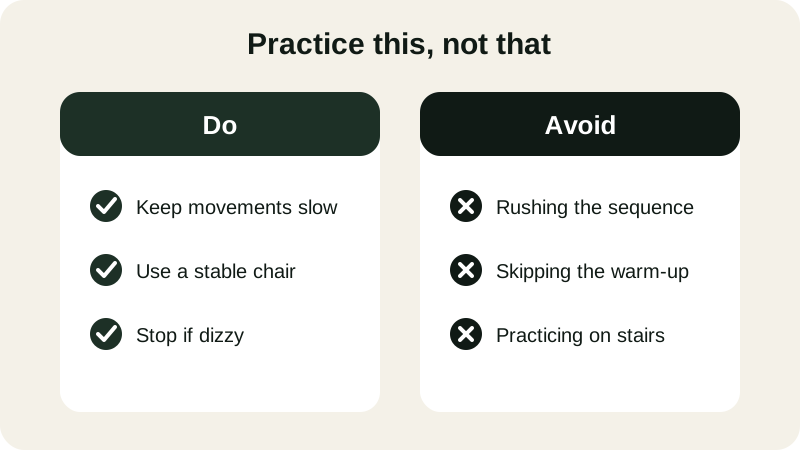
- Do: keep movements slow, use a stable chair, and stop if dizzy.
- Avoid: rushing the sequence, skipping the warm-up, and practicing on stairs.
Another easy mistake is comparing yourself to the screen. A video or app shows one pace, but your own pace only needs to work for your own body on that particular day. Slowing the movement down even further, pausing between repeats, or skipping a step you're not ready for are all reasonable choices, not shortcuts.
Screen setup matters too. Place your device where you can see the whole screen without tilting your head down or straining your neck, and turn the volume up enough that you can follow along with your eyes closed during a seated section. A steady, comfortable setup removes one more distraction from a practice that's meant to feel unhurried.
For a seated alternative on days when floor space or standing balance is the issue, our chair Tai Chi guide walks through the same unhurried style of movement from a chair, which pairs well with the seated qigong moves above.
However you choose to practice, the format matters less than showing up for a few quiet minutes, most days, at a pace that feels unhurried and kind to your joints.
Sources
Is qigong the same as tai chi?
Not quite. Tai chi flows through a connected sequence of postures, while qigong is often made of shorter, repeated movements paired with breath. Both share the same slow, meditative pace, so if you enjoy one you will likely enjoy the other.
Do I need any equipment to start qigong at home?
No special equipment is needed. A clear patch of floor or a sturdy chair is enough for most sessions. Comfortable clothing and bare feet or soft shoes work well, and a stable chair, wall, or counter nearby helps with any balance-based moves.
Can qigong be practiced sitting down?
Yes. Most qigong moves, including wave hands and gentle weight shifts, adapt easily to a seated position. A seated practice works well on days when standing feels tiring or unsteady, and it still brings the same slow, breath-led focus.
What if I feel unsteady during a session?
Stop moving, sit down if a chair is nearby, and rest until you feel steady again. Keep a stable chair, wall, or counter within reach during every session, and check with a doctor first if dizziness happens often.