 DAILY TAI CHI
Hip Thrusts vs Tai Chi: Which Builds Hip Strength?
Hip thrusts build glute strength through resistance while tai chi builds hip mobility and balance through slow, standing movement, and many people benefit from doing both.
Published
Quick answer
In the hip thrusts vs tai chi comparison, hip thrusts build glute strength through resisted hip extension, while tai chi is a slow, standing practice for hip mobility, balance, and calm breathing. Many people choose to do both.
Key takeaways
- Hip thrusts build glute strength with resistance; tai chi builds hip mobility and balance through slow movement.
- Tai chi is low-impact and lets you move at your own pace; hip thrusts usually need a bench or added weight.
- Pairing both covers strength and movement quality rather than choosing just one.
- Start light with hip thrusts and keep a stable chair or wall nearby for tai chi balance work.
- Check with a doctor first if hip pain limits your movement before adding either practice.
Weighing hip thrusts against tai chi comes down to what your hips actually need. Thrusts load the glutes with resistance to build strength, while tai chi retrains how your hips move, balance, and bear weight through slow, standing practice.
What's the difference between hip thrusts and tai chi?
Hip thrusts are a resistance exercise, usually done lying on the floor or with your shoulders braced on a bench, lifting the hips up against weight to strengthen the glutes. Tai chi is a slow, standing practice of continuous movement and breath that trains hip mobility, balance, and calm focus instead of building muscle load.
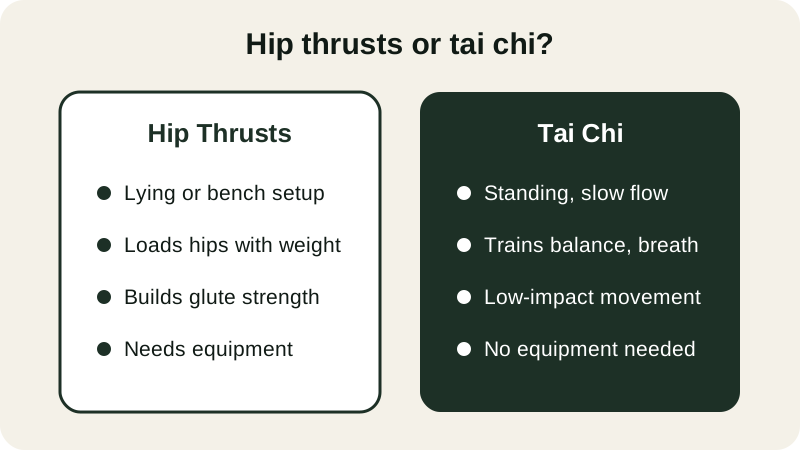
- Hip thrusts: lying or bench setup, loads hips with weight, builds glute strength, needs equipment.
- Tai chi: standing, slow flow, trains balance and breath, low-impact movement, no equipment needed.
Both involve your hips, but they ask different things of them. A hip thrust is a single repeated motion against resistance — strength training for the back of your body. Tai chi strings together many small, flowing movements, like gentle weight shifts and a heel-to-toe stand, that ask your hips to stabilize and move through a full range rather than push against load.
Neither one is inherently "better" in isolation — they sit in different categories of exercise altogether. A hip thrust is closer to what a physical therapist might call a strengthening movement, while tai chi fits into the mobility and balance category. Knowing which category a given day calls for makes the choice easier than trying to pick one winner.
How hip thrusts target your glutes and hips
A hip thrust works by pressing your hips upward against resistance, usually with your upper back supported on a bench or sturdy chair and your feet flat on the floor. The motion is short and repeated, and the resistance can come from your own body weight, a band, or a weighted bar across the hips.
This kind of loaded movement is useful for building muscle around the hip joint, which can make everyday tasks like rising from a chair or climbing stairs feel steadier. It's a strength-focused exercise, not a balance or mobility practice, so it pairs naturally with something slower and more flowing.
Form matters more than the amount of weight used. Keeping your chin tucked, your ribs stacked over your hips, and pressing through your heels rather than your toes protects your lower back while your glutes do the work. If a weighted version feels like too much right now, a bodyweight hip thrust off the floor or a slow sit-to-stand from a sturdy chair builds some of the same strength with far less setup.
| Aspect | Hip Thrusts | Tai Chi |
|---|---|---|
| Movement type | Single resisted motion | Continuous, flowing moves |
| Typical setting | Floor, bench, or gym | Standing, open floor space |
| Equipment | Bench, bar, or band | None needed |
| Main focus | Glute and hip strength | Balance, mobility, calm |
| Impact on joints | Moderate load | Low-impact |
What tai chi does for hip mobility and balance instead
Tai chi doesn't load your hips with resistance the way a thrust does. Instead, it moves your hips through gentle weight shifts, slow turns, and single-leg holds that build mobility and steadiness over weeks of regular practice.
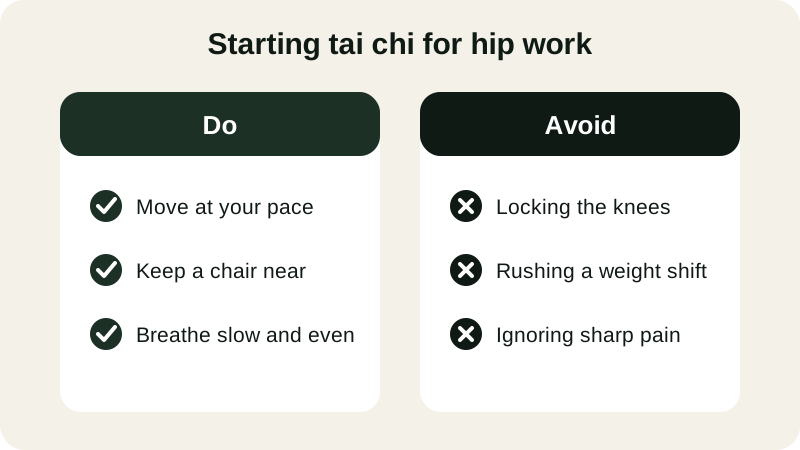
- Do: move at your pace, keep a chair near, breathe slow and even.
- Avoid: locking the knees, rushing a weight shift, ignoring sharp pain.
Our guide to tai chi for hip pain walks through specific moves that ease stiffness without strain, and the piece on how tai chi improves balance explains why these slow weight shifts matter for steadier footing over time.
Because tai chi never asks you to rush, it suits people who find traditional strength moves intimidating, or whose hips feel too stiff for a deep resisted motion right now. A session might ask you to shift your weight from one foot to the other a dozen times, turn slowly from the waist, or hold a single-leg stand near a wall for a few slow breaths — none of it loud, none of it jarring.
If you'd rather be guided through this standing practice step by step, the app builds a 28-day path of short sessions — each with a warm-up, main flow, and cool-down — shown one move at a time, with 5, 10, 15, or 20+ minutes a day to choose from. More on how that's structured is in the app's guided sessions.
Which one should you choose, or can you do both?
Yes, many people do both. Hip thrusts build glute strength with resistance, and tai chi builds hip mobility, balance, and calm through slow movement, so together they cover strength and movement quality in a way neither one does alone.
If hip thrusts feel too intense right now, or you simply want to start somewhere lower-key, tai chi is the more forgiving entry point. Our beginner's guide to tai chi covers the basics of stance, breath, and pace, and the balance exercises for adults over 60 offer a few more slow movements to pair with it.
Think about the week ahead rather than a single day. A realistic pattern might be two or three short sessions of hip thrusts spread across the week, with a few minutes of tai chi on most of the other days. Neither needs to be long to be worthwhile — short, regular sessions tend to add up to more steady progress than occasional long ones.
Over time, you may find your preference shifts depending on how your body feels. Some weeks call for the structure of counted repetitions; others call for nothing more than a quiet standing flow. Either way, the goal is the same — hips that move easily and support you through an ordinary day, whichever exercise gets you there.
Can tai chi replace hip thrusts for hip strength?
Tai chi won't load your hips the way a resisted hip thrust does, so it's not a direct swap for building glute strength. Its slow weight shifts and standing postures do build hip mobility and steadiness over time, and pairing both gives you strength and movement quality together.
Do you need a gym to do hip thrusts?
Not necessarily — hip thrusts can be done at home with just a sturdy chair, couch edge, or mat on the floor, with or without added weight. A gym bench and barbell let you add more resistance, but bodyweight versions work well for building basic hip strength.
Is tai chi enough exercise on its own?
Tai chi offers balance, mobility, and calm breathing, which many people find covers their daily movement goals well. If you also want more muscle-building hip strength, pairing it with resistance work like hip thrusts covers both the strength and movement-quality sides of fitness.
Which is gentler on sore hips, hip thrusts or tai chi?
Tai chi is usually the gentler day-to-day choice, since it's low-impact and lets you set your own pace, while hip thrusts add direct load to the joint. If hip pain is new, sharp, or ongoing, check with a doctor first before starting either one.