 DAILY TAI CHI
App to Track Tai Chi Practice Progress in 28 Days
A simple daily log of date, moves, minutes, and how you felt turns a few minutes of tai chi practice into visible, trackable progress.
Published
Quick answer
The simplest app to track tai chi practice progress is a daily log: date, moves practiced, minutes spent, and how you felt. A calendar or streak chart makes the pattern visible within a few weeks of short sessions.
Key takeaways
- Log the date, moves practiced, minutes spent, and how you felt after each session
- A calendar mark or streak chart shows your practice pattern at a glance
- Watch for small signs like a steadier heel-to-toe stand, not big sudden changes
- Short sessions of 5 to 10 minutes are easier to track consistently than occasional long ones
- Note which moves, like wave hands or a single-leg stand, still feel hardest
You can track your tai chi practice progress with a simple daily log — the date, which moves you practiced, how long you went, and how your body felt afterward. A few weeks of that short record shows your progress far more clearly than memory alone.
This guide walks through what's worth writing down, simple ways to keep that log, and the small signs — like a steadier heel-to-toe stand — that tell you the practice is working.
What should you track in a tai chi practice?

Track four things after each session: the date, which moves you practiced, how many minutes you spent, and one honest note on how you felt — looser, calmer, wobblier, or tired. That's enough detail to spot real patterns within a few weeks, without turning practice into homework.
- Date and length. Even five to ten minutes counts — write down what you actually did, not what you planned.
- Moves practiced. Note whether you did a weight shift, wave hands, or tried a single-leg stand.
- How you felt. Steadier, stiffer, calmer — this matters more than the clock.
- Anything that felt hard. A wobble during the heel-to-toe stand is useful information, not a failure.
- One word for breathing. Easy, shallow, or slow — breathing often changes before balance does.
Keep the entries short on purpose. A log you can fill in thirty seconds after standing up is one you'll actually keep for weeks, and weeks of entries are what reveal a pattern — a single day never does.
Simple ways to log your sessions
A paper notebook by your practice spot works as well as anything fancier. Mark an X on a calendar for every day you practice, or keep a short running list with the date and a word or two about how it went.
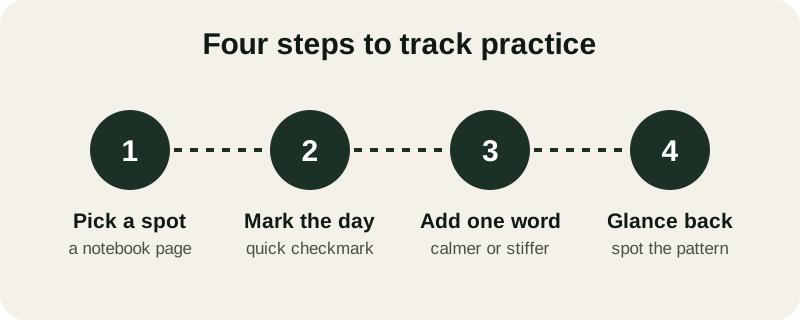
- Pick a spot. A notebook page or wall calendar near where you practice.
- Mark the day. A quick checkmark the moment you finish.
- Add one word. Calmer or stiffer — whatever's true that day.
- Glance back weekly. Look for a pattern, not perfection.
None of this needs to be fancy. A spreadsheet works if you already use one, a plain calendar works if you don't, and a folded index card tucked into a drawer works just as well as either. The tool matters far less than whether you actually open it after each session.
How can you tell your balance or breathing is improving?
Notice small, specific signs: holding a heel-to-toe stand a little longer before wobbling, feeling steadier during a single-leg stand, or breathing slower without thinking about it. These small shifts, not big leaps, are what real progress in a tai chi practice tends to look like.
If you want to understand why these particular signs show up, our guide on how tai chi improves balance explains the slow weight shifts behind them.
What progress looks like over the weeks
Early sessions often feel awkward — even a simple weight shift can feel like a lot to think about at once. That eases with repetition. Most people find moves feeling more familiar after a few weeks of short, regular sessions, not through sudden change but through small, repeated ease.
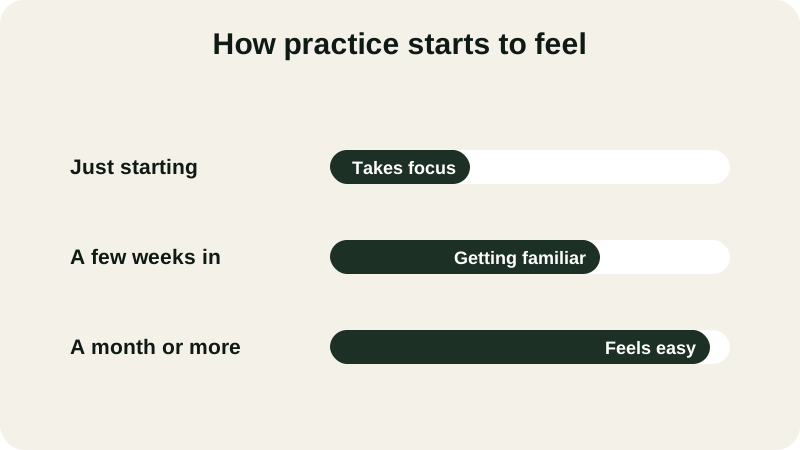
| Stage | How it tends to feel |
|---|---|
| Just starting | Takes focus |
| A few weeks in | Getting familiar |
| A month or more | Feels easy |
Your log is what turns this general pattern into your own specific story. Without it, "a few weeks" is just a phrase. With it, you can look back and see the exact day the heel-to-toe stand stopped feeling wobbly, or the week ankle circles started feeling automatic instead of effortful.
How does a guided 28-day path help you track progress?
Yes. Daily Tai Chi builds a personalized 28-day path of short, guided sessions — a warm-up, main flow, and cool-down of 10 to 30 moves shown one at a time, in 5, 10, 15, or 20+ minute lengths. A daily reminder at a time you choose makes the pattern easy to see alongside your own notes.
Why structure doubles as a log
Because the path runs day by day, simply seeing which day you're on works like a built-in calendar. Pair that with your own short note on how a session felt, and you get both the structure and the personal detail a plain day count can't capture on its own. App sessions are done standing, with spoken cues and a short video clip for each move, so your hands stay free for the one thing a screen can't track for you: how the move actually felt in your body.
A few practical notes before day one
The app is available on iPhone and Android, with the first 4 days free and no card or account required to try it. It sends anonymous usage and crash statistics in the background, and unlocking a locked day later on can involve an optional ad — worth knowing upfront, even though none of it affects the log you keep yourself. There's no seated or chair version built into the app itself; if standing isn't comfortable some days, our chair Tai Chi guide is worth following on its own, and you can still log those sessions the same simple way.
However you keep track — notebook, wall calendar, or a daily reminder at a time you choose — the real marker of progress is simple: are you showing up a little more often than last month? For more ideas on fitting short sessions into each day, see our guide to daily tai chi practice, or set your own cue with our guide on setting a daily reminder for tai chi practice.
Which app can track tai chi practice progress for me?
Daily Tai Chi builds a personalized 28-day path of short, guided sessions with spoken cues and a short video clip for each move, available on iPhone and Android. The first 4 days are free, with no card or account needed, so you can see how the structure fits your own log before committing.
Do you need any equipment to track tai chi practice at home?
No special equipment is required — just stand tall, feet hip-width apart, with a stable chair, wall, or counter nearby for support. A notebook or calendar is all you need for the tracking itself; the practice stays as simple as the log you keep beside it.
How long should a tracked tai chi session be?
Most beginners track sessions of 5 to 10 minutes, which is plenty to notice patterns over a few weeks. Length matters less than consistency — a short session logged most days builds a clearer picture of progress than one long session logged occasionally.
What if you miss a day while tracking your practice?
Mark it honestly and move on — a gap in the log is still useful information, not a setback. Pick back up the next day with the same short routine; missing one day rarely undoes the progress built over previous weeks of steadier practice.