 DAILY TAI CHI
Tai Chi for Core Strength: Try the Single-Leg Stand
A gentle explainer on how tai chi builds core strength through slow weight shifts, wave hands, and standing balance postures like the single-leg stand.
Published
Quick answer
Tai chi builds core strength through slow weight shifts, wave hands, and standing postures like the single-leg stand, which quietly engage your abdominal and back muscles without crunches or equipment. A few minutes most days is enough to feel steadier through your middle.
Key takeaways
- Slow weight shifts and wave hands engage your core without crunches or sit-ups.
- Standing tall with feet hip-width apart activates deep abdominal and back muscles.
- The single-leg stand challenges your core most — keep a chair or wall nearby.
- A few minutes most days builds steadier core strength over time.
- No equipment needed — just a clear patch of floor and comfortable clothes.
Tai chi builds core strength in a quiet, low-impact way: slow weight shifts, wave hands, and simple standing postures ask your deep abdominal and back muscles to hold you steady, with no crunches or sit-ups required.
Think of it less as a workout and more as meditation in motion. The core stability you build happens almost by accident, as you learn to stand tall, breathe slowly, and shift your weight smoothly from one foot to the other. This kind of core stability also supports the balance work covered elsewhere on this site, since a steady midsection is often what keeps your upper body quiet while your feet do the moving. Over a few weeks, that quiet engagement adds up to real abdominal strength you can feel in everyday movements — getting up from a chair, reaching for something on a high shelf, or walking on uneven ground.
What does tai chi do for your core?
Tai chi strengthens your core by training the muscles that keep you upright and balanced — not through sit-ups, but through slow posture work and controlled weight shifts that your deep abdominal and lower-back muscles must engage just to keep you steady.
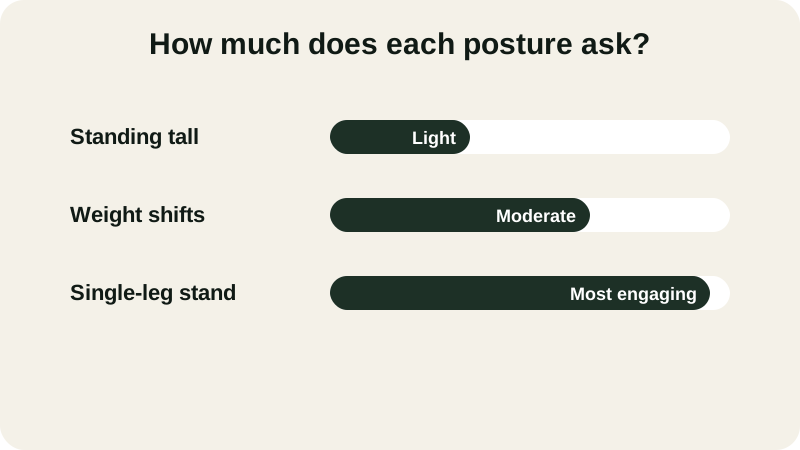
- Standing tall: light core engagement
- Weight shifts: moderate core engagement
- Single-leg stand: the most engaging posture
Think of your midsection as the quiet anchor for everything else. When you stand tall with feet hip-width apart, your core switches on gently just to hold your spine upright and your shoulders relaxed over your hips. As you shift your weight slowly from one leg to the other, those same muscles work a little harder to keep your hips level and your torso from wobbling side to side.
This is different from how a gym class usually trains the core. There's no holding a plank until your arms shake, and no counting repetitions. Instead, your core does its work in the background, bracing just enough to support slow, controlled motion. That said, if you already enjoy more traditional ab exercises, there's no need to give them up — tai chi simply offers another, gentler approach to the same goal of a strong, stable core.
Five moves that engage your core muscles
A handful of familiar tai chi moves do most of the work here. None of them look like exercise in the traditional sense — they simply ask your core to do its job while you move slowly and keep your breath even.
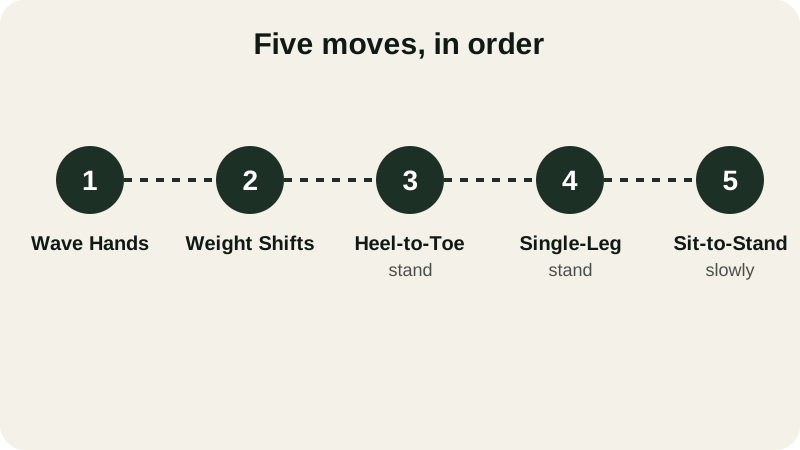
- Wave hands: turning gently at the waist while your arms float from side to side
- Gentle weight shifts: rocking slowly between your feet, heel to heel
- Heel-to-toe stand: balancing with one foot placed directly in front of the other
- Single-leg stand: lifting one foot just an inch or two off the floor
- Slow sit-to-stand: rising from a chair at an unhurried, controlled pace
Of these, the single-leg stand and the slow sit-to-stand tend to ask the most of your core, because your midsection has to stabilize your whole body with less support underneath you. Wave hands and gentle weight shifts are a good place to start if you're newer to tai chi core exercises, since both can be practiced with your feet firmly planted the whole time.
Start with a stable chair, wall, or counter within easy reach, and only lift your foot an inch or two off the floor until balancing feels comfortable. You can always rest a fingertip on the chair for support as you build confidence.
How often should you practice for core strength?
A few minutes most days is enough — five to ten minutes of slow weight shifts and standing postures, repeated regularly, does more for your core than one long session now and then.
Consistency matters far more than duration when you're trying to strengthen your core gradually. A short session every day builds the habit of engaging those muscles correctly, while an occasional long session mostly builds fatigue. Many people find it easiest to pair a few tai chi moves with something they already do daily, so the practice doesn't compete with an already busy schedule.
If you'd like these moves guided step by step, Daily Tai Chi builds a personalized 28-day path of short sessions, each with a warm-up, main flow, and cool-down. App sessions are done standing, with 10 to 30 moves per session, and spoken cues plus a short video clip for each move, so you can see exactly how a weight shift or a single-leg stand should look before you try it yourself.
Building core work into a daily routine
You don't need a mat, weights, or special clothing to begin. A clear patch of floor, comfortable clothes, and five to ten minutes of unhurried time is plenty to start noticing a difference in how steady you feel.
Pair these moves with something you already do each day — right after you brush your teeth, or before your morning coffee — so the habit sticks without relying on extra willpower. Some people like noticing how their balance feels during a single-leg stand each week, as a simple, low-pressure way to track slow, steady gains in core stability. A simple note in a calendar can help, but even just noticing you feel steadier reaching for a top shelf is a good sign the practice is working.
For a broader sense of how these same slow movements support your footing, see our guide on how tai chi improves balance. If you'd like to build strength through your arms and shoulders alongside your core, our piece on tai chi for upper body strength covers the holding the ball move in detail. And if standing for long stretches isn't comfortable yet, the chair tai chi guide offers a seated way to begin building the same steady strength.
Sources
Can tai chi replace traditional core exercises like planks or crunches?
Tai chi works your core differently rather than replacing targeted exercises — it builds steadiness through slow weight shifts and standing postures instead of isolated reps. If you enjoy planks or crunches, keep doing them alongside tai chi; many people find the two complement each other, one building raw strength and the other building control and balance.
Do you need any equipment for tai chi core work?
No special equipment is needed — just a clear patch of floor, comfortable clothing, and a stable chair, wall, or counter nearby for support during balance moves like the single-leg stand. Bare feet or flat, flexible shoes both work well.
Is tai chi core practice safe if you have back pain?
Tai chi's slow, low-impact movements are generally easy on the back, but everyone's situation differs. Move slowly and listen to your body, and if your back pain is active or severe, a brief check-in with a doctor first can help you choose which postures to skip or adapt.
How soon might you feel a difference in your core strength?
Most people notice feeling steadier standing or rising from a chair within a few weeks of practicing five to ten minutes most days, though this varies depending on how often you practice and your starting point.