 DAILY TAI CHI
Tai Chi for Beginners With No Experience: 5 First Moves
A plain-language starting guide to tai chi for complete beginners, covering the stance, five first moves, and how long to practice each day.
Published
Quick answer
Tai chi for beginners with no experience starts with a tall, relaxed stance and a few slow moves like gentle weight shifts and wave hands, done for five to ten minutes near a stable chair or wall. No flexibility, equipment, or exercise background is required to begin.
Key takeaways
- Stand tall, feet hip-width apart, with a stable chair, wall, or counter within reach.
- Start with a few core moves: gentle weight shifts, wave hands, and ankle circles.
- Five to ten minutes a day is enough for true beginners to start building a habit.
- Stop if you feel dizzy or unsteady, and check with a doctor first if you have health concerns.
- No mat, equipment, or exercise background needed — just comfortable shoes and open floor space.
If you have no experience at all, tai chi for beginners can start exactly here: stand tall, breathe slowly, and try one move at a time. You don't need flexibility, equipment, or any exercise background to begin today.
Maybe you've watched a slow, graceful group moving together in a park, or a friend mentioned how calm they feel afterward. Tai chi is often called meditation in motion, and it was built for people starting completely from scratch — including adults 55 and older who have never tried a structured exercise practice before.
What do you need to start tai chi with no experience?
You need almost nothing: comfortable flat shoes, a few feet of floor space, and a stable chair, wall, or counter nearby for balance. No mat, no special clothing, and no past fitness experience — tai chi movements are slow and low-impact, so a true beginner of any age can start exactly where they are.
Your starting position matters more than any fancy move. Stand tall, feet hip-width apart, knees soft, and let your shoulders drop away from your ears. From that position, every movement is just a slow shift of weight or a soft sweep of the arms — nothing needs to be memorized perfectly on day one, and nobody is watching to correct you.
There's no uniform, no partner, and no sequence you have to prove you know before you're "allowed" to begin. If you can stand, sit, or hold onto a chair for a minute, you can start right now. For a fuller walk-through of this stance and your very first few minutes, see our step-by-step guide for beginners.
Five first moves worth learning
A small handful of moves covers most of what a beginner needs for the first several weeks. Each one is slow, repeatable, and easy to practice alone once you've tried it a few times.
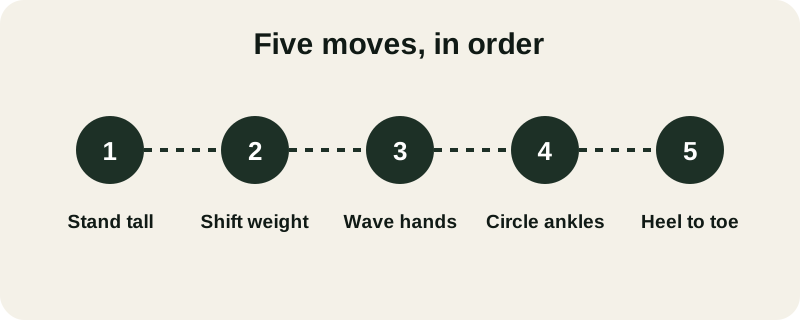
- Stand tall. Feet hip-width apart, knees soft, hands resting easily at your sides.
- Shift weight. Rock your weight slowly from one foot to the other, like a pendulum.
- Wave hands. Let your arms float side to side in front of you, as if smoothing calm water.
- Circle ankles. Lift one heel and trace a few slow circles to loosen the ankle.
- Heel to toe. Place one foot directly in front of the other and hold near a chair.
None of these moves require balance you don't already have. If the heel-to-toe stand feels wobbly at first, keep two fingers resting on the back of a chair until it feels steadier — there's no rush to let go, and no version of this that's done "wrong" if you move slowly and stay within what's comfortable.
How long should a beginner practice each day?
Five to ten minutes a day is enough when you're just starting, and that's all some beginners ever need to feel the benefit of a short daily habit. Longer sessions can come later, once the first few moves feel familiar in your body.
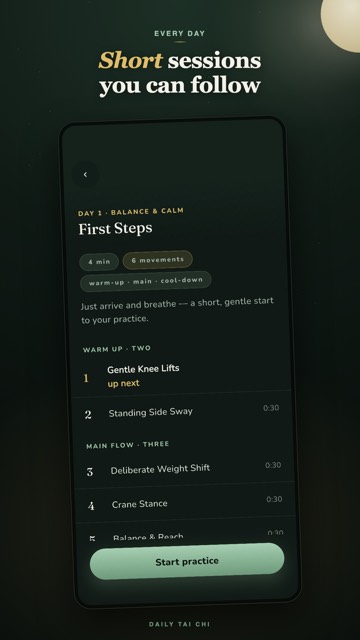
What matters far more than length is simply showing up again tomorrow. A few minutes most days adds up to far more steady practice than one long session every couple of weeks. If you'd rather follow along than guess at the order of moves, Daily Tai Chi builds a personalized 28-day path out of short, guided sessions — each one done standing, with a warm-up, main flow, and cool-down, and you choose 5, 10, 15, or 20-plus minutes a day. The first 4 days are free, with no card and no account needed, so you can try a full week's worth of sessions before deciding if it fits your routine. It works on iPhone and Android.
Mistakes beginners make early on
A few habits can make tai chi feel harder than it needs to be, especially in the first week or two, often because they're carried over from faster forms of exercise.
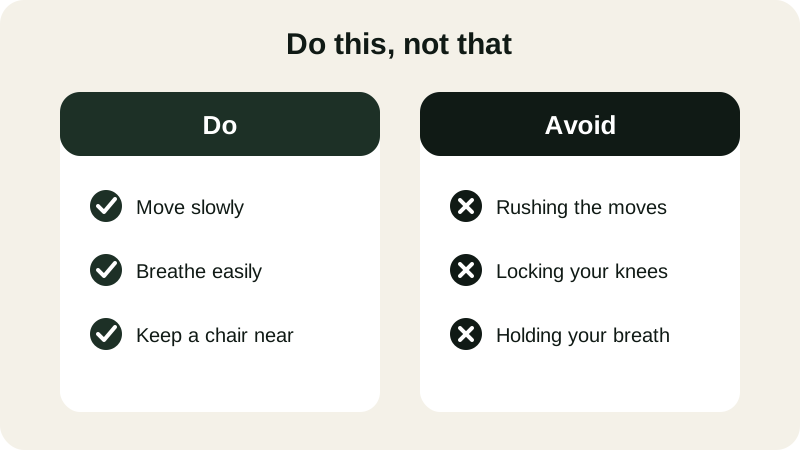
- Do: move slowly, breathe easily, and keep a chair near.
- Avoid: rushing the moves, locking your knees, and holding your breath.
Most of these habits fade on their own once you slow down. Think of each move as something to settle into rather than get through — a slower weight shift is doing more for your balance than a fast one ever would.
Where to go once the basics feel steady
Once stand-tall, weight shifts, and wave hands feel familiar in your body, you can start exploring moves with real names, like a single-leg stand or a slow sit-to-stand, and begin linking a few together into a longer flow. None of this needs to happen on a fixed schedule — some beginners spend a month on the first five moves alone, and that's time well spent.
Our guide to common tai chi move names is a good next stop if you want to recognize what you're doing by name rather than just by feel. And if standing for a full session still feels like too much on some days, our chair tai chi guide walks through the same slow ideas from a seated position.
There's no test to pass and no form you need to get exactly right on day one. Beginners who return to a few easy minutes most days tend to feel steadier within the practice itself, simply because showing up slowly, again and again, is the whole method — not a warm-up for something harder later.
Sources
Can I learn tai chi if I've never exercised before?
Yes. Tai chi is slow and low-impact by design, so it doesn't assume any fitness background. Start with a few basic moves like weight shifts and wave hands, go at your own pace, and build from there — plenty of lifelong beginners start exactly this way.
Is tai chi hard to learn for older beginners?
Not in the way a sport might be. The movements are slow and repeated, so older beginners often pick up the basics within the first few sessions. If a stance feels unsteady, hold a chair or wall for support until it feels more natural.
Do I need to be flexible before starting tai chi?
No. Tai chi doesn't require deep stretches or splits — most moves are gentle weight shifts, slow arm sweeps, and soft turns. Flexibility tends to improve gradually through regular, easy practice rather than being a requirement to begin.
What should I wear for my first tai chi session?
Comfortable, loose clothing you can move in, and flat shoes with a flexible sole — or bare feet on a non-slip floor. Avoid anything restrictive around the waist or shoulders, since the arm movements work best when nothing pulls or binds.
Can beginners practice tai chi sitting down?
Many of the same slow principles adapt well to a chair, including gentle arm movements and weight shifts in the seat. A seated, chair-based routine is a good alternative on days when standing feels like too much.